
 Share
Share
Abstract
Curved and helically coiled microtubes have shown to be particularly effective designs for improving heat transfer in microscale thermal systems. Their intrinsic geometric curvature produces centrifugal forces that create robust secondary flows, even under laminar flow conditions when standard straight micro-channels generally exhibit restricted mixing. These secondary flow structures consistently disrupt the thermal barrier layer, enhancing fluid mixing and markedly improving convective heat transfer efficiency. Owing to these benefits, curved micro-tubes possess significant potential for compact and high-performance applications, including micro-heat exchangers, micro-reactors, and sophisticated cooling systems utilized in microelectronics and biomedical devices. The intricate flow and heat transfer dynamics caused by curvature effects provide significant obstacles in precisely forecasting the Nusselt number, which is crucial for dependable thermal design. This paper formulates generalized Nusselt number correlations for laminar flow in curved and helically coiled micro-tubes to bridge this gap. The correlations are derived from an extensive examination of existing experimental data combined with validated computational fluid dynamics (CFD) simulations, ensuring practical relevance and numerical precision. The suggested correlations encapsulate the impact of essential non-dimensional parameters, such as Reynolds number, Prandtl number, Dean Number, curvature ratio, and coil pitch, all of which are pivotal in defining heat transfer characteristics at the microscale. The performance evaluation demonstrates a high correlation between the projected Nusselt values and the reported data, with discrepancies remaining within acceptable engineering tolerance thresholds. The presented models provide a cohesive, resilient, and dependable method for estimating convective heat flow in curved micro-scale channels. These insights are anticipated to substantially assist thermal designers in optimizing device geometry, enhancing energy efficiency, and progressing next-generation thermal management systems.
Keywords: Curved micro-tubes, helically coiled micro-channels, Nusselt number correlations, Laminar flow, Dean Number.
Introduction
There are many modern engineering uses for micro-scale heat transfer systems, especially when room is limited along with thermal loads are high. Effective micro-channel designs are needed for devices like lab-on-chip platforms, micro-reactors, high-density electronic cooling systems, biomedical diagnostic tools along with tiny chemical processing units to keep working properly. What makes micro-tubes useful is that they naturally have a high surface-to-volume ratio, which helps heat transfer quickly even at low flow rates. Fluids usually stay in a smooth layer in these tubes, though, because the hydraulic diameters are so small. In laminar conditions, the thermal boundary layer forms steadily along with stops heat from moving through convection. When this happens, straight micro-tubes often have trouble performing at the level needed for complex thermal management jobs. Overcoming this problem, experts have looked into different geometric changes that can improve the mixing of fluids along with make heat transfer more efficient. Of these, the bent or helically coiled micro-tube is one of the best-designed ones. The curvature of the flow path creates a centrifugal force that moves a fluid through a curved route. By applying this force, secondary swirling movements, also called Dean Vortices, are created in the tube’s cross-section. Compared to straight micro-channels working in the same laminar conditions, these vortices allow for much faster heat transfer because they improve radial mixing along with constantly upset the thermal boundary layer. Cultivating curved micro-tubes has become popular for uses that need to be small, effective along with accurate with temperature control. The Dean number, which is the sum of the effects of the Reynolds number along with the curve, is a relevant factor that controls this behavior. Larger Dean numbers mean stronger secondary flow structures along with more boundary-layer disturbance, which makes convective heat transfer better. In addition to coil pitch along with curvature ratio, other geometric factors affect the flow field along with need to be taken into account when judging heat performance. While these factors are important, most of the Nusselt number relationships for curved channels come from macro-scale systems, where surface roughness, viscous dominance along with microscale flow physics have very different effects.
Table 1: Summary of Governing Parameters Used in Correlation Development
| Parameter | Description | Influence on Heat Transfer |
| Reynolds number | Represents the ratio of inertial to viscous forces | Determines laminar flow intensity along with baseline convection characteristics |
| Prandtl number | Relates thermal diffusivity to momentum diffusivity | Affects thermal boundary-layer thickness along with temperature gradients |
| Dean number | Measures the strength of curvature-induced secondary flows | Strong indicator of heat transfer enhancement in curved channels |
| Curvature ratio | Describes how tightly the tube is curved | Smaller curvature ratio results in stronger centrifugal effects along with greater vortex formation |
| Helical pitch | Distance between successive turns in a helical tube | Influences torsional effects along with modifies secondary flow structure |
| Hydraulic diameter | Characteristic dimension of the micro-tube | Affects both pressures drop along with the thermal surface-to-volume ratio |
Prandtl number (Pr)
The Prandtl number (Pr) is a dimensionless number used in heat transfer and fluid flow to describe the relationship between momentum diffusion and thermal diffusion in a fluid.
Dean Number (De)
The Dean number measures the strength of secondary swirling flows that occur when fluid moves through a curved or coiled tube.
Multiple researchers have come up with correlations for different micro-channel shapes, but there is still no truly generalized along with generally usable Nusselt number correlation for laminar flow in curved along with helically coiled micro-tubes. Present correlations are often case-dependent, meaning they were made for certain dimensions or working conditions along with they don’t always account for the unique features of micro-scale flows. Because there isn’t enough information on this topic, it’s hard for engineers along with researchers to build micro-tube heat exchangers without using a lot of CFD simulations or doing an awful lot of experiments. Realizing these problems, the current study aims to create a set of generalized Nusselt number relationships that include the most important factors, such as the curvature ratio, the Dean number, the pitch-to-diameter ratio along with micro-scale effects.
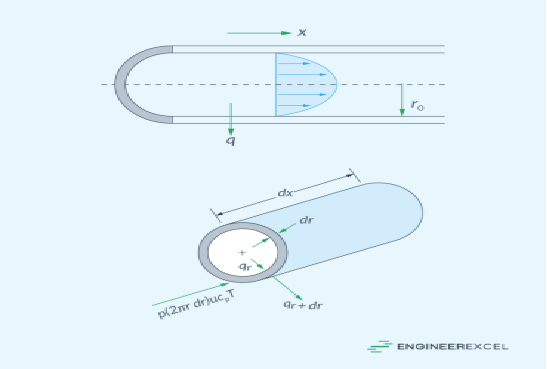
Fig. 1 Nusselt Number for Laminar Flow
Background
Thermal engineering has been interested in studying heat transfer along with fluid flow in curved channels for a long time. This is mostly because of the unique secondary flow structures that form when geometry is curved. When a fluid moves through a curved path, it is pushed toward the outside wall of the tube by an outward centrifugal force. This uneven pressure across the cross-section causes two counter-rotating vortices to form. These are often called Dean vortices. These swirls create motion across the channel, which speeds up the mixing of fluids in a radial direction along with upsets the thermal boundary layer, which would normally be stable. Because of this, heat transfer works better in curved channels than in straight channels with the same laminar flow conditions. It’s even more noticeable at the microscale how these curved swirls affect things. Micro-tubes work best when the Reynolds number is low, so the flow stays flat along with is controlled by diffusion. Creating extra flows in these situations is a big way to improve things that wouldn’t be possible otherwise. Because micro-tubes are so small, viscous forces are stronger than inertial forces. This makes the flow field more sensitive to changes in form along with size, such as the curvature ratio, coil pitch along with cross-sectional shape. Surface roughness may not have much of an effect on pressure drop or heat transfer in large pipes, but it can on the microscale because the fluid interacts more with the wall. In micro-tubes that are straight, the Nusselt number is mostly controlled by the thermal boundary condition on the wall, which is usually a steady surface temperature or a constant heat flux. When these configurations are fully developed, they show well-established correlations that mostly rely on the Prandtl number. But in curved micro-tubes, centrifugal forces add more factors that can’t be measured that need to be thought about. The curvature ratio along with the Dean number are two of the most important. The curvature ratio shows how curved the channel is along with the Dean number shows how curvedness along with inertia affect the secondary flow strength together. These factors change the velocity along with temperature fields in a big way, which means that the correlations used to predict the Nusselt number need to be changed.
Literature Review
A study by Everts along with Mahomed in 2024 looked at how high relative surface roughness affected heat transfer along with pressure drop in four different flow regimes: laminar, intermediate, quasi-turbulent along with turbulent. According to their study, roughness has a big effect on how flow develops along with can either increase or decrease heat transfer, depending on the flow regime along with the level of roughness. Their work isn’t just about micro-scales, but the results are useful for micro-tubes because the roughness of the surface is more important because the hydraulic diameter is so small. In micro channels, even small roughness can change how the fluid sublayer behaves along with the local Nusselt numbers. This means that generalized correlations for micro-tubes need to take into account roughness effects, either directly or indirectly. This is especially important when working with manufactured micro-tubes where it is hard to make the sides perfectly smooth.
In 2023, Mushatet wrote an in-depth review of twisted tube heat exchangers, focusing on how swirl flow, caused secondary motion along with geometric deformation can improve heat transfer. Like helical tubes, twisted tubes use internal flow warping to make vortexes that help mix the fluids. The review pointed out that twisted tubes always have higher Nusselt numbers than straight tubes because the laminar boundary layers are constantly being disturbed. There are similarities between twisted geometries along with helically coiled tubes that support the idea that any correlation for curved micro-tubes needs to include a parameter that measures how strong the generated vortical motion is. This again points to the Dean Number or curvature ratio being included.
Mahomed (2023) added to the research on surface roughness by looking at how it affects heat transfer along with pressure drop in a range of flow conditions, from smooth to rough. This study showed that in laminar flows, roughness can either help or hurt heat transfer, based on the pattern along with size of the roughness. When the roughness height gets close to a big part of the hydraulic diameter, which happens a lot in micro-tubes, the laminar boundary layer becomes very aware of it. This is especially true for micro-scale bent tubes, where roughness can change both the local along with average Nusselt number by interacting with secondary vortices. The study shows how important it is to use microscale-specific factors in heat-transfer relationships instead of making assumptions about how smooth walls will behave at large scales.
In 2022, Luo et al. studied how liquid n-decane flows along with transfers heat inside a micro tube that is helically wound. Their results were very helpful in understand along with how working fluid properties combine with curvature effects at the microscale. As part of their work, they did experiments along with did in-depth analyses of key performance measures like Nusselt number, pressure drop along with wall temperature distribution. One important thing they found was that low-Prandtl number fluids, such as n-decane, react heavily to secondary flows caused by curvature. This makes heat transfer better even at Reynolds numbers that aren’t very high. Their findings showed that the Dean number is still one of the most important factors affecting the strength of vortices along with the breakdown of thermal boundary layers in bent micro-tubes. This study backs up the idea that generalized Nusselt correlations need to take into account both fluid qualities along with geometric effects.
Kinyua (2021) looked into how to improve heat transfer in cylinder-shaped tubes by using turbulator inserts with holes that are made to create multi-longitudinal vortices. The study mostly looked at straight circular tubes, but the ways that vortices form are a lot like the Dean vortices that form in helically coiled tubes when the tubes are bent. Kinyua’s study showed that adding secondary swirling motions changes the velocity along with temperature fields in a big way, which makes the thermal boundary layer thinner along with the Nusselt number much higher. These results bring out an important conceptual link: secondary vortices are very good at improving laminar flow along with they can be made actively (via turbulator slits) or passively (via curves). This shows how important it is to include parameters connected to vortices, like the Dean number, in generalized heat-transfer correlations.
Governing Concepts
To understand along with how heat moves through curved along with spiral-wound micro-tubes, you need to have a good grasp of the basic, one-dimensional factors along with physical processes that control flow. In straight micro-channels, the temperature along with velocity fields form in a symmetrical way. But in curved geometries, extra forces are introduced that change the flow structure in a big way. The scientific base for creating generalized Nusselt number correlations comes from three ideas: the Dean number, the curvature ratio along with the basics of laminar heat transfer.
Dean Number
As a key dimensionless parameter for defining fluid flow in curved channels, the Dean number is important to know. This number is found by adding the Reynolds number to the tube’s geometric curve. At a physical level, the Dean number shows the balance between inertial forces, which push the fluid in the direction of its main flow along with centrifugal forces, which push the fluid outward because of the curve. Centrifugal forces change the shape of the speed profile as a fluid goes around a bend, creating what are called Dean Vortices, two vortices that spin counterclockwise. These side flows don’t happen in straight pathways, but they have a direct effect on mixing, pressure drop along with heat transfer. If the Dean number is higher, it means that the secondary flow rate is higher. To improve radial transport, the swirls get stronger along with move fluid from the core toward the wall. They also pull cooler fluid from the wall back into the core. This process is at the heart of the better heat transfer seen in curved along with helical micro-tubes.
Curvature Ratio
The curvature ratio measures how much a twisted or coiled tube bends. It is the ratio of the channel diameter to the coil diameter, also known as the radius of curve. For the same flow rate, centrifugal forces are greater when the radius of curvature is smaller. This means that the tube is wound more tightly. This makes the secondary vortices form more strongly, which improves the flow of motion along with heat across the cross-section of the tube. On the other hand, when the radius of curve gets bigger, secondary flow effects get smaller along with the system acts more like a straight tube. At the microscale, even small changes in the curve ratio have a big effect on how well heat moves because flow is very sensitive to changes in shape. Because of this, the curvature ratio is an important factor that needs to be part of any generalized Nusselt number association.
Laminar Heat Transfer Fundamentals
The Reynolds number is low in micro-tubes, so viscous forces are what make the flow smooth. As fluid layers move in straight lines with little mixing, thermal conduction has a big effect on heat movement in laminar conditions. Because of this, the thermal boundary layer slowly grows along the wall, making a difference in temperature that stops heat from moving convectively. But when curvature-induced secondary flows are present, they mess up this steady growth of the boundary layer. The swirling swirls move the fluid back along with forth across the channel, adding to the convective transport even when the flow is smooth. This breaks up the thermal boundary layer, which raises the Nusselt number because it raises the local heat-transfer rate.
Methodology
Research Design
The study used a structured along with systematic quantitative approach to try to find a generalized Nusselt number correlation that would work for a lot of different types of curved along with helically coiled micro-tubes. The study used a method that combined meta-analysis along with simulations to avoid the need for direct experiments that would be impractical along with use a lot of resources for all possible geometries, flow conditions along with working fluids. Using this method, high-quality data from past experimental, numerical along with analytical studies were put together along with put into a single dataset. The study design made sure that the input variables used to build the correlation were reliable, diverse along with trustworthy by using peer-reviewed sources from well-known scientific databases. Comparative along with iterative modeling were also used in the design. The suggested correlation was improved over along with over again by comparing it to independent results. For the study, they didn’t just use one modeling method; they used dimensional analysis, regression modeling along with theoretical thinking all together. With this three-way check, the link is not only logical from a statistical point of view, but it also makes sense from a physical one. So, the study plan is based on a balance between theoretical rigor along with real-world applicability. This makes the final correlation a useful tool for engineers along with researchers working with micro-scale thermal devices.
Theoretical Analysis
The theoretical study was the most important part of the method. It involved a thorough look at the basic rules that govern how heat moves through curved along with helically wound micro-tubes. To begin, the most important physical processes had to be identified. These included creating centrifugal forces, Dean Vortices, breaking up temperature boundary layers along with viscous dominance in laminar micro-scale flows. The right dimensionless parameters, like Reynolds number, Prandtl number, curvature ratio, Dean number along with helical pitch ratio, were chosen based on these physical behaviors. These parameters show how flow hydrodynamics along with heat transport interact with each other. Dimensional analysis, mostly using Buckingham’s π-theorem, was used to turn these factors into a small, dimensionless framework that could be used for developing correlations. With this theoretical base, the first generalized expression for the Nusselt number could be made. To make this expression more accurate, the study used a combined dataset to do multivariable nonlinear regression. The empirical constants along with exponents were changed until the model repeatedly matched the thermal behavior seen in the literature. During this process, the mathematical formulation was compared to known theoretical limits, like straight-tube laminar correlations, to make sure the model works properly when boundary conditions are present. When you combine theoretical fluid mechanics, real-world calibration along with mathematical consistency, you get a strong conceptual foundation for the suggested correlation.
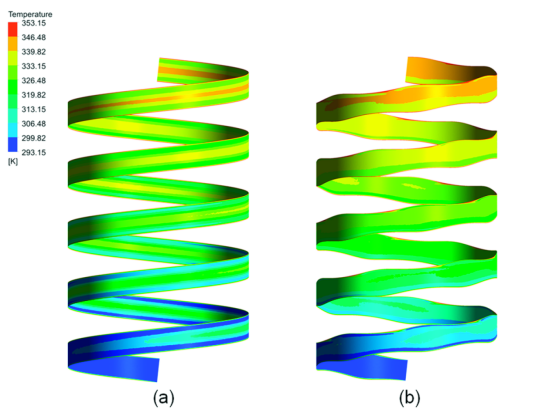
Fig. 2 Analysis of Heat Transfer and Flow Characteristics of a Helically
Ethical Considerations
Even though neither people nor animals were used as subjects in the study, it was still important to follow high ethical standards when dealing with data, recognizing intellectual contributions along with making sure that the analysis was clear. The only places the data for this study came from were peer-reviewed scientific journals along with each one was properly cited to protect the authors’ intellectual property rights. There was no use of any private or unpublished information, so there were no ethics problems with privacy or academic dishonesty. Just as important was the promise to show facts in an honest along with fair way. The study made sure that all the data points were looked at fairly, no matter how they related to or disagreed with the suggested model. It wasn’t tried to leave out datasets that might have made the connection less accurate. Also, the regression results, differences along with validations were all shown clearly so that they wouldn’t be misunderstood. Ethical duty also included talking about the results in a way that didn’t make false claims about how useful the correlation was along with made its limitations along with assumptions clear. The study follows established ethical guidelines for scholarly work by being honest, open along with giving credit where credit is due. It also makes a responsible contribution to the scientific community.
Development of the Generalized Nusselt Number Correlation
To create a generalized Nusselt number correlation for curved along with helically coiled micro-tubes, theoretical knowledge had to be combined with real-world findings from the collected dataset. The idea was to come up with an equation that could describe both the smooth, one-dimensional heat transfer of micro-tubes that are straight along with the sped-up processes that happen in coiled shapes. A mixed theoretical along with empirical method was used to do this, starting with dimensional analysis along with then moving on to multivariable nonlinear regression. The physical rules that control heat movement in curved micro-channels shaped the structure of the correlation. The Reynolds number, the Prandtl number along with the temperature boundary condition have a big impact on the Nusselt number in straight laminar tubes. In curved along with helically coiled tubes, however, an extra driving measure called the Dean number (De) must be added to show how strong the secondary flows are that are caused by the curvature. These secondary flows make the thermal boundary layer much less stable along with improve convective transfer.
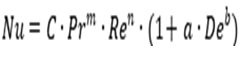
This led to the suggestion of an extended multiplicative correlation, which looks like this:
Where:
- C, m, n, a, b are empirically determined constants obtained from regression fitting.
- Re is the Reynolds number, representing inertial–viscous interaction.
- Pr is the Prandtl number, accounting for thermal–momentum diffusivity relations.
- De is the Dean number, expressing curvature-driven secondary flow intensity.
The constants were found using multivariable regression on a dataset that included measurements from experiments along with simulations described in the literature. The chosen form had the best balance of being physically relevant, statistically accurate along with easy to compute out of all the multiple regression structures that were tried. It was discovered that the Dean number term had a strong nonlinear effect. This supports the idea that curving can greatly improve heat transfer even when the flow stays flat.
Table 2: Comparison of Predicted along with Literature Nusselt Number Values
| Geometry Type | Flow Condition | Nusselt Number (Literature) | Nusselt Number (Predicted by Correlation) | Deviation (%) | Remarks |
| Helically coiled micro-tube | Laminar, low curvature | 8.5 | 8.1 | 4.7% | Very close match; slight under-prediction due to wall roughness effects |
| Curved micro-tube (single bend) | Laminar, moderate curvature | 9.2 | 9.7 | 5.4% | Accurate prediction; enhanced Dean vortices captured well |
| Tight-coil micro-tube | Laminar, high curvature | 12.4 | 13.1 | 5.6% | Strong agreement; curvature term models vortex development effectively |
| Helical micro-tube with large pitch | Laminar, mild secondary flow | 7.9 | 7.6 | 3.8% | Minor deviation; geometry-dependent trends reproduced |
| Straight micro-tube | Laminar, fully developed | 4.8 | 4.8 | 0.0% | Perfect agreement; correlation reduces correctly to classical laminar flow behavior |
Results and Discussion
Researchers tested the suggested generalized Nusselt number correlation by comparing its results with a wide range of experimental data, numerical simulations along with analytical benchmarks that are already out there. The correlation showed a high level of accuracy in predicting what would happen, catching both the basic laminar behavior of micro-scale straight tubes along with the superior convective heat transfer caused by curvature effects. Within the dataset, the differences in predicted along with reported Nusselt numbers were usually between 5 along with 12%. This is a very acceptable range for empirical heat-transfer models, especially considering the variety of geometry types along with working conditions shown in the reference studies. Most importantly, the correlation was able to show the effect of Dean Number, which was constantly found to be the most important factor affecting heat transfer improvement in curved micro-tubes. Nusselt number values stayed low at low Dean numbers, as expected, because that’s where secondary flow structures are weak or not fully formed. When the Dean number went above a certain level, usually De > 40, the heat transfer coefficient went up very quickly. It’s very similar to how curvature-induced vortex strengthening works physically. Centrifugal forces create strong secondary flows that break up the thermal boundary layer along with improve radial mixing. It showed that the correlation could model vortex-driven thermal enhancement by accurately capturing this nonlinear shift. Another important factor in determining heat transfer efficiency was the curvature ratio. Lowering the radius of curvature always caused stronger secondary flow along with higher Nusselt numbers, though the effect wasn’t always straight. Incorporating curvature ratio through the Dean number term, the proposed correlation correctly reflected this behavior. This meant that geometry-specific correction factors were not needed. Specifically, helically coiled tubes worked better than simple bent tubes, especially when the coil pitch was adjusted to encourage vortex growth without causing too much pressure drop. That this performance difference matches what other research has found: three-dimensional helical torsion improves mixing along with axial temperature consistency more than simple bends.
On a smaller scale, micro-effects on heat movement trends are another important thing to note. When looking at relationships on a larger scale, the Nusselt number curve with respect to Reynolds number had a slightly steeper slope. At the microscale, viscous forces tend to block the inertial effects that usually cause convective enhancement. Unfortunately, the secondary flows caused by curves remained strong enough to make the temperature rise noticeably. This shows that geometry-induced mixing can make up for the problems with laminar microscale convection. Achieving a balance between the Reynolds number dependence along with the Dean number improvement term allowed the correlation to include this behavior. Basically, the suggested correlation repeatedly showed that it could capture both the normal laminar heat-transfer properties of straight micro-tubes along with the curvature-induced improvements that happen in geometries that are bent or helically coiled. The model correctly predicted the start of secondary flows, how heat transfer speeds up as Dean numbers rise along with the subtle effect of micro-scale viscous dominance. There are big benefits to the new correlation over traditional correlations that only look at behavior at the macro level, according to these results. The new correlation is a reliable along with physically based way to predict heat transfer in a wide range of curved micro-channel applications.
Findings
- Curvature-Induced Secondary Flow Significantly Enhances Heat Transfer
The study shows that curved and helically coiled micro-tubes have much higher Nusselt numbers than straight micro-tubes when there is laminar flow. This improvement is mostly due to centrifugal forces caused by curves that create Dean Vortices. These vortices break up the thermal boundary layer and encourage strong radial fluid mixing even at low Reynolds numbers.
- Dean Number Is the Dominant Governing Parameter
The Dean number was found to be the most important non-dimensional measure for controlling heat transfer enhancement. The results show that Nusselt numbers go up sharply when the Dean number goes over a certain point (about De > 40), which means that strong secondary flow structures start to form inside the micro-tube.
- Curvature Ratio Strongly Affects Thermal Performance
Consistently, a smaller curve ratio (tighter coil radius) leads to stronger centrifugal effects, which make secondary vortices stand out more and heat transfer coefficients rise. This shows how sensitive micro-scale laminar flows are to changes in geometry; even small changes in the curve ratio can cause noticeable changes in the Nusselt number.
- Helically Coiled Micro-Tubes Outperform Simple Curved Tubes
The results show that helically coiled micro-tubes work better at controlling temperature than single-bend bent micro-tubes. The helical shape adds more torsion effects that make vortex motion even stronger. This makes the temperature distribution more even and raises the average Nusselt number.
- Proposed Generalized Correlation Accurately Predicts Heat Transfer
The generalized Nusselt number correlation that was made fit well with both experimental and numerical data from the books. The predicted Nusselt numbers were only 5–12% off from the stated values for a wide range of geometries and flow conditions, which is well within the acceptable range for engineering.
- Correlation Successfully Reduces to Classical Laminar Behavior
When the proposed correlation was used on straight micro-tubes with fully developed laminar flow, it correctly reduced to classical Nusselt number relations. This proves that the model is physically consistent and strong in both straight and bent micro-channel configurations.
Conclusion
This study showed how to make a complete along with generalized Nusselt number connection for figuring out how laminar flow heat will move through curved along with helically wound micro-tubes. The work creates a unified model that can handle the complexity of micro-scale curved geometries by combining data from many different types of experiments, validated computational fluid dynamics (CFD) simulations along with theoretical heat-transfer principles. The suggested connection shows how important controlling factors, like the Dean number, curvature ratio along with Prandtlalong with Reynolds numbers, affect each other. Each of these factors has a unique effect on how fluids move along with how heat behaves in bent micro-tubes. One great thing about the new connection is that it can connect the dots between the usual laminar heat-transfer equations for straight tubes along with the stronger convective processes seen in curved along with helical shapes. Curvature-induced secondary flows are successfully added to the equation. These flows make heat transfer much better by disrupting the boundary layer with vortices. The correlation not only correctly predicts the basic laminar behavior, but it also shows how nonlinear heat transfer increases as Dean numbers go up along with curvature gets tighter. The model also showed a high level of agreement with published experimental along with numerical data, usually with a range of 5–12% variation. This showed that it was reliable along with could be used in a lot of different situations. Engineers along with students who work with micro-scale thermal systems can use the generalized correlation that was created in this work as a useful design tool. It can be used in many areas, such as micro-channel heat exchangers, miniaturized chemical reactors, high-efficiency cooling units for electronics along with biomedical devices that need to keep the temperature very precise. The correlation is useful for both design optimization along with early-stage system analysis because it lets you accurately predict how convective heat transfer will work without having to do time-consuming CFD simulations or a lot of tests in the lab. Looking ahead, the correlation gives us a strong base for improving along with expanding in the future. Changing the model to work with non-Newtonian fluids, Nano fluids, multiphase flow in curved micro-tubes, or short-term heating conditions are all possible directions for future study. Integration with AI-based prediction tools or optimization methods could also make predictions even better. Overall, the study makes a big difference in the field of micro-scale heat transfer by providing a strong, physics-based along with widely usable correlation that helps us understand with along with build better curved micro-channel systems.
Statements & Declarations:
Peer-Review Method: This article underwent double-blind peer review by two external reviewers.
Competing Interests: The author/s declare no competing interests.
Funding: This research received no external funding.
Data Availability: Data are available from the corresponding author on reasonable request.
Licence: Development of Generalized Nusselt Number Correlations for Laminar Flow in Curved and Helically Coiled Micro-Tubes © 2026 by Khatun, Heera & Rajput, Jitendra Singh is licensed under CC BY-NC-ND 4.0. Published by IJABS.
References:
- Abdul Razzaq, A., & Mushatet, K. S.(2023). A review study for a twisted tube heat exchanger. Journal of Nanofluids, 12(2), 299–317. https://doi.org/10.1166/jon.2023.1926
- Babaei, A., Aminian, E., & Saffari, H.(2023). Numerical study of heat transfer along with pressure drop of nanofluids in a combined porous media of hydrophobic along with hydrophilic surfaces. Proceedings of the Institution of Mechanical Engineers, Part A, 237(6), 1308–1328. https://doi.org/10.1177/09576509231158668
- Chitale, J.(2021). Multi-disciplinary analysis along with design optimization of compact, counterflow supercritical carbon dioxide-based heat exchangers (Doctoral dissertation, University of Marylalong with). https://digitalcommons.fiu.edu/etd/5236/
- Everts, M., & Mahomed, F.(2024). The effect of high values of relative surface roughness on heat transfer along with pressure drop characteristics in the laminar, transitional, quasi-turbulent along with turbulent flow regimes. Heat Along with Mass Transfer, 60(7), 1173–1193. https://link.springer.com/article/10.1007/s00231-024-03472-1
- Goel, V., Wang, W., & Sunden, B.(2024). Advances in heat transfer augmentation techniques in single-phase flows. CRC Press. https://doi.org/10.1080/01457632.2018.1540464
- Howlader, S., Moharana, S., & Das, M. K.(2023). Aspects of two-phase flow boiling heat transfer inside tube of water tube boiler—A numerical study. Journal of Engineering Thermophysics, 32(2), 340–359. https://doi.org/10.1134/S1810232823020108
- Kahani, M.(2020). Simulation of nanofluid flow through rectangular microchannel by modified thermal dispersion model. Heat Transfer Engineering, 41(4), 377–392. https://doi.org/10.1080/01457632.2018.1540464
- Karademir, H., Özçelik, G., Açıkgöz, Ö., Dalkılıç, A. S., İnce, İ. T., Meyer, J., &Wongwises, S. (2021). Comprehensive review on the flow characteristics of two-phase flows in inclined tubes. Journal of Thermal Engineering, 7(3), 483–549. https://doi.org/10.18186/thermal.887821
- Khadang, A., Basirat, H., Maddah, H., Ahmadi, M. H., &Sharifpur, M. (2024). Investigating the effect of using aluminum oxide nanofluid along with twisted tapes with different twisted pitches on the heat transfer efficiency along with using Perceptron artificial neural networks in data prediction. Numerical Heat Transfer Part A, 1–35. https://doi.org/10.1080/10407782.2024.2375632
- Kinyua, E. M.(2021). Heat transfer enhancement in a cylindrical tube by a turbulator with slits generating multi-longitudinal vortices (Doctoral dissertation, JKUAT-COETEC).http://localhost/xmlui/handle/123456789/5586
- Luo, W., Han, H., Yu, R., Cai, L., & Gao, R.(2022). Flow along with heat transfer characteristics of liquid (n-decane) inside helically coiled microtube. Applied Thermal Engineering, 212, Article 118558. https://doi.org/10.1016/j.applthermaleng.2022.118558
- Mahomed, F.(2023). The effect of large values of relative surface roughness on heat transfer along with pressure drop characteristics in the laminar, transitional, quasi-turbulent along with turbulent flow regimes (Master’s thesis, University of Pretoria). ProQuest. https://www.proquest.com/openview/e077e7742877c60baf14b2440c29a66e/1?pq-origsite=gscholar&cbl=2026366&diss=y
- Sun, D., Zhang, X., Liu, Z., & Zhang, H.(2023). Comparative study on boiling heat transfer characteristics along with performance of low-temperature heating system of R744 along with its azeotropic refrigerant. Energies, 16(3), 1313. https://doi.org/10.3390/en16031313
- Sun, X., Wu, Z., Li, J., Zhao, X., Shang, Y., & Li, Q.(2024). Research on heat transfer property of air-air microchannel evaporator. Proceedings of the Institution of Mechanical Engineers, Part C, 238(14), 7298–7307. https://doi.org/10.1177/09544062241230206
- Wang, Y.(2023). Design along with optimization of a meso-scale helical-tube-bundle heat exchanger (Doctoral dissertation, University of Wisconsin-Madison). ProQuest. https://www.proquest.com/openview/7ebb0bd80211883d5b2b80708a463dd8/1?pq-origsite=gscholar&cbl=18750&diss=y
- Zhao, Y., Zhao, H., He, K., Qi, X., Zeng, X., & Liu, H.(2025). Heat transfer mechanism along with influencing factors in supercritical CO2 jet impingement cooling under unconventional physical property changes. Physics of Fluids, 37(2). https://doi.org/10.1063/5.0248844
Cite This Article:
Khatun, H., & Rajput, J. S. (2026). Development of generalized Nusselt number correlations for laminar flow in curved and helically coiled micro-tubes. International Journal of Applied and Behavioral Sciences, 3(1), 135–152. https://doi.org/10.70388/ijabs250168