
 Share
Share
Abstract
Nonlinear integral equations (NIEs) appear in many applications in physics, engineering, and other scientific disciplines. The equations are often difficult to solve analytically or numerically because of their nonlinear nature. Special functions, which are solutions to certain classes of differential equations, provide a solid foundation for dealing with such complex problems. This paper discusses the application of special functions in solving nonlinear integral equations, with emphasis on their utility in simplifying and solving these equations. The key special functions applied are Bessel functions, Gamma functions, Legendre polynomials, and Hyper-geometric functions, which find their application in different forms of nonlinear integral equations arising in quantum mechanics, fluid dynamics, and electrical engineering. It includes such methods as perturbation techniques, fixed-point iteration, and transforms methods that make use of the special functions to solve solutions. Therefore, by providing an explicit link between the abstract theory of mathematics and practical application, this paper does great work on showing how significant contributions the special functions made to studying and solving nonlinear integral equations.
Keywords:Non-linear Integral Equations, Special Functions,BesselFunctions,GammaFunction,Hyper-geometricFunctions,PerturbationMethods,Fixed-Point Iteration.
Introduction
Nonlinear integral equations (NIEs) are a class of mathematical equations that play a vital role in modeling a wide range of physical, biological, and engineering systems. Unlike linear equations, in which the unknown function appears only linearly, nonlinear integral equations involve terms where the unknown function appears inside the integral and may be raised to a power or composed with other nonlinear operations. This nonlinearity complicates these equations to some extent and makes them require advanced mathematical techniques and special functions to be solved.
Nonlinear integral equations are very common in fluid mechanics, quantum mechanics, electrical engineering, and population dynamics. For instance, in fluid dynamics, they may represent the time evolution of turbulent flows; in quantum mechanics, many-body interactions or scattering problems might result in such equations. They are used in modeling nonlinear circuits and systems in electrical engineering. Generally, nonlinear integral equations have been known to be very challenging to solve because of the complexity involved in the nonlinearity; however, special functions, which happen to be solutions to famous classes of differential equations, have been a crucial tool for solving nonlinear integral equations. These functions, like Bessel functions, Gamma functions, Legendre polynomials, or Hyper-geometric functions, always seem to appear in contexts associated with physical problems under constraints of symmetry, boundary conditions, or other specific kinds of constraints. Their well-defined properties like recurrence relations, asymptotic expansions, and integral representations have been found to be extremely valuable when complex nonlinear integral equations are sought to be solved.
The purpose of this paper is to explore the role of special functions in solving nonlinear integral equations. We start by providing an overview of the types of nonlinear integral equations encountered in various scientific disciplines. Then, we investigate how special functions can simplify the solution process, either by providing exact solutions, approximations, or by offering methods for numerical solutions. Finally, we take a look at several specific applications, such as problems arising in quantum mechanics, fluid dynamics, and electrical engineering, to present the reader with a flavor of the applicability of these functions toward real-world problems.
From the interaction between nonlinear integral equations and special functions, it is our hope that this article will contribute to a better comprehension of how these mathematical instruments can be used to help solve some of the biggest problems in modern science and engineering.
Overview of Nonlinear Integral Equations
A nonlinear integral equation generally has the form:
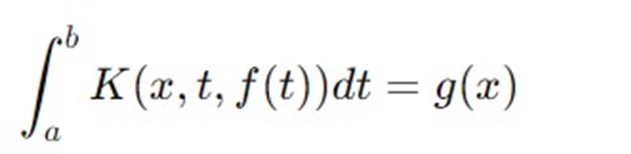
where f(t) is the unknown function, K (x,t,f(t)) is a nonlinear kernel, and g(x) is a known function. Nonlinear integral equations are classified based on the nature of the nonlinearity. Some of the most common types include:
Volterra Integral Equations: The kernel depends only on the integration variable
t alone. These equations often arise in time-dependent problems.
Fredholm Integral Equations: The kernel depends on both independent and integration variables. These equations often arise in spatially dependent problems.
Nonlocal Integral Equations: The integrals are extended over a range of values, not merely in local vicinity.
Special Functions and Their Significance in Nonlinear Integral Equations
Special functions in the subject involve math functions that come out to appear as solutions to certain kinds of classes of differential equations and integrals, commonly encountered in the application of mathematical physics and engineering. Such functions contain some properties like recurrence relations and integral representations. Some of them involve Bessel functions, Hyper-geometric functions, Legendre polynomials, and the Gamma functions. These, again, make them indispensable to tackle the analysis and solution for a nonlinear integral equation.
This section discusses the characteristics of special functions, their relevance in simplifying and solving nonlinear integral equations, and highlights their applications in a variety of scientific fields.
Overview of Special Functions
Special functions are defined through specific equations or integral representations, and their properties are extensively tabulated and studied. Some of the most commonly used special functions in the context of nonlinear integral equations include:
- Bessel Functions (Jn(x), Yn(x)):Solutions to Bessel’s differential equation, they often arise in problems with cylindrical symmetry, such as heat conduction, wave propagation, and fluid mechanics.
- Gamma Function (Γ(x)): A generalization of the factorial function to complex numbers, the Gamma function frequently appears in integral transforms and fractional calculus.
- Hyper-geometric Functions (2F1(a, b; c; x)): These generalize series expansions and occur in problems involving difficult geometries or boundary conditions.
- Legendre Polynomials (Pn(x)): Problems often have spherical symmetry involving potential theory or quantum mechanics.
- Hermite and Laguerre Polynomials: Used quite frequently when problems arise in the context of wave functions and the Schrödinger equation.
Role of Special Functions in Nonlinear Integral Equations
Special functions are vital in the reduction and solving of nonlinear integral equations. This is primarily because special functions have defined properties, and they occur in relation to physical problems. The most important contributions to their uses include the following:
Exponential Solutions
Many nonlinear integral equations can be exactly solved when their solutions are stated in terms of special functions. Some examples include the following:
- Bessel functions solve some integral equations describing wave propagation in cylindrical coordinates.
- Hypergeometric functions often occur in systems with several interacting parts or with certain symmetry properties.
Simplification of Complexity
Special functions ease the treatment of complex kernels of integrals. One may represent a kernel with some complicated exponential or trigonometric term by Gamma or Bessel functions, thus making it easier to analyze and compute.
Series and Asymptotic Expansions
Special functions have well-studied series and asymptotic expansions, which are useful for approximating solutions to nonlinear integral equations. These expansions often serve as the foundation for perturbation or iterative methods.
Analytical Representation
The properties of special functions, such as orthogonality and integral representations, allow for analytical manipulations that can transform nonlinear integral equations into simpler forms. For instance:
- Orthogonality properties of Legendre and Bessel functions often come in handy when solving boundary value problems.
- Integral representations of Gamma and Hypergeometric functions allow direct computation of solutions.
Numerical Computation
Many special functions are included in the computational software, such as MATLAB, Mathematica, and the Python library SciPy, allowing numerical evaluation with a relatively good efficiency. Such evaluation is very useful for nonlinear integral equations that do not admit a closed-form solution but can be represented in terms of special functions.
Applications of Special Functions in Nonlinear Integral Equations
Quantum Mechanics
Special functions play a very important role in quantum mechanics. The phenomena of particle scattering, quantum field interactions, and wavefunction dynamics are described by nonlinear integral equations. For instance:
- Bessel functions occur in the radial part of the Schrödinger equation in cylindrical coordinates.
- Spherical harmonics and Legendre polynomials occur in angular parts of equations describing systems with spherical symmetry.
Fluid Dynamics
In fluid dynamics, specific functions help solve integral equations modeling flow through complex geometries or at nonlinear boundary conditions. One example:
- Modified Bessel functions are used to model thermal transfer in nonhomogeneous media.
- Hypergeometric functions appear in the exact solutions to the Navier-Stokes equations in the following special cases.
Electromagnetic Theory
Integral equations describing wave transmission in nonlinear media often include some special functions. Example:
- Gamma and Beta functions arise in solving equations for wave attenuation in plasmas.
- Bessel functions occur in waveguides and antenna theory, which are dominated by cylindrical geometries.
Fractional Calculus
Fractional integral and differential equations that generalize classical calculus often contain special functions such as the Mittag-Leffler function or the Gamma function. These functions make it easier to analyze memory effects or anomalous diffusion in systems.
Nonlinear Circuit Analysis
Special functions are also deployed to describe nonlinear circuits, say due to diodes and transistors, in electrical engineering. In many instances, they result in nonlinear integral equations whose solutions require the gamma function, Hypergeometric functions etc.
Examples of Nonlinear Integral Equations Containing Special Functions
Nonlinear Kernel Containing Bessel Functions:An integral equation to depict the wave propagation through cylindrical space can be: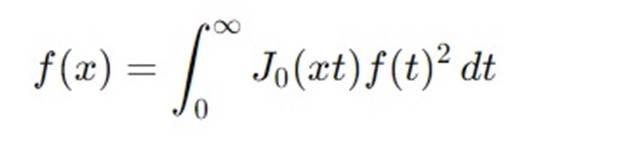
Here, (J_0(x)) is the Bessel function of the first kind, which simplifies the radial part of the problem.
Equation Involving Gamma Functions:
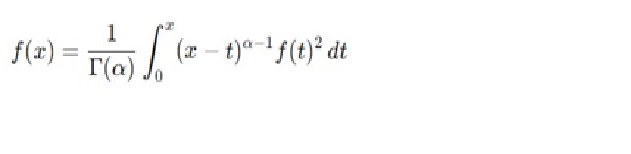
In systems governed by fractional calculus, an equation may involve:
The Gamma function is an analytic representation of the fractional integral kernel.
Hypergeometric Function in Population Dynamics:
A nonlinear equation modeling population growth could take the form: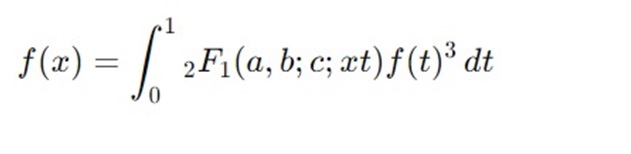
The Hypergeometric function 2F1 arises due to the nonlinearity in the interaction term.
Advantages of Using Special Functions
Universality: Special functions appear in diverse physical problems, making them versatile tools for solving nonlinear integral equations across different fields.
Rich Mathematical Properties: Their recurrence relations, orthogonality, and integral representations allow for analytical and numerical manipulations.
Efficiency: Computational tools make it easy to evaluate special functions, enabling quick solutions to otherwise complex problems.
Special functions are extremely important in the study and solution of nonlinear integral equations. They are able to simplify complicated kernels, allowing for either exact or approximate solutions and even numerical computations. Special functions are cornerstones of modern applied mathematics: they enable the solution of a vast variety of nonlinear integral equations that appear in practically all fields of applications to both theoretical insight and technological innovation.
Methods of Solving Nonlinear Integral Equations Using Special Functions
Nonlinear integral equations are complex in nature, making it a difficult task to solve them. Special functions play an important role here either by simplifying the equation or being a part of the solution. The methods to solve NIEs will be discussed here, which involve special functions in analytical, approximate, and numerical methods.
Analytical Methods
Analytical techniques are aimed at finding exact solutions for NIEs. Where applicable, they are very efficient and very deep in understanding the problem.
Transform Techniques
Transforms such as Laplace and Fourier transforms transform the NIEs into simpler algebraic or differential equations in which special functions arise naturally.
Example: In the equation
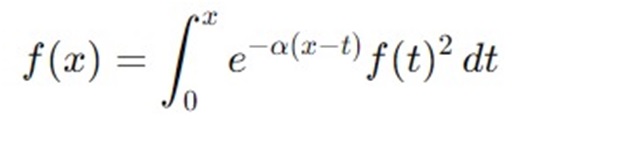
Applying the Laplace transform reduces the problem to a solution in terms of the Gamma function.
Green’s Functions
The Green’s functions are used in solving integral equations by reducing them into boundary value problems. When the domains are symmetric, the Green’s functions for NIEs often contain special functions like Bessel functions or Legendre polynomials.
Differential Equation Reduction
Some NIEs can be expressed as differential equations by means of differentiation. This reduces the problem considerably since many special functions are known solutions to well-known differential equations.
Approximation Methods
When exact solutions cannot be obtained, approximation methods have to be used. Special functions often represent approximations or expansions of the solution.
Perturbation Techniques
In perturbation methods, the solution is expanded as a series based on a small parameter. Each term in the series can involve special functions, simplifying the iterative computation.
Example: Expanding the kernel of an NIE as a power series: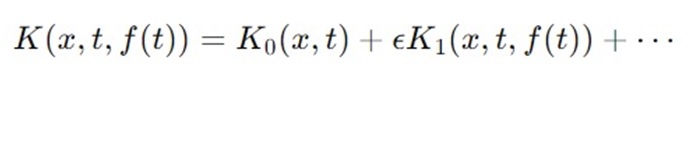
The resulting equations may be solved using special functions like Legendre polynomials or Hypergeometric functions.
Asymptotic Expansions
Asymptotic methods approximate solutions for large or small parameter values. For instance, the asymptotic form of the Bessel function helps approximate solutions to NIEs involving oscillatory kernels.
Example: The asymptotic behavior of Bessel functions
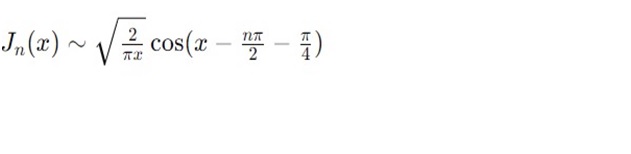
simplifies solutions at large values of x.
Iterative Methods
Iterative methods solve NIEs by successively refining an initial guess until convergence is achieved. Special functions are often used as initial approximations or trial solutions.
Successive Substitution
The simplest iterative method involves repeatedly substituting an initial guess f0(x) into the equation: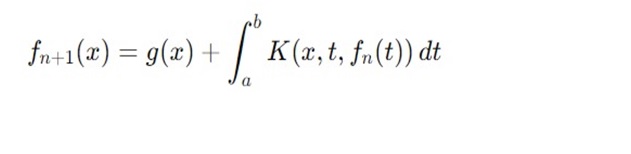
Special functions like polynomials or orthogonal functions (e.g., Legendre polynomials) are often used as the initial guess f0(x)to accelerate convergence.
This method iteratively substitutes the solution into the equation. Special functions can be used as the starting point due to their simple and well-defined properties.
Newton-Kantorovich Method
For equations of the form: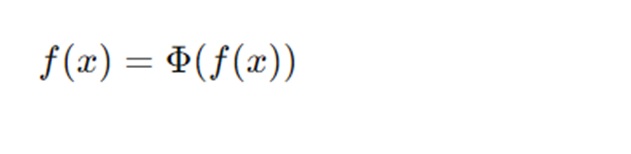
where Φ is a nonlinear operator, fixed-point iteration methods can be used. Special functions are frequently employed in approximating Φ or in analyzing the convergence of the method.
Numerical Methods
Numerical methods are a must in solving complex NIEs that cannot be solved analytically. Special functions are crucial in enhancing the accuracy and efficiency of such methods.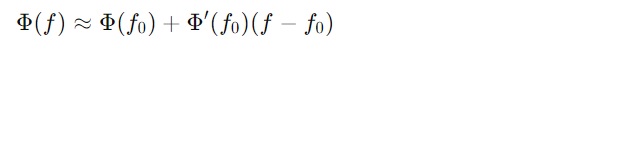
The resulting linear equation is often solved using special functions.
Collocation Methods
Collocation methods approximate the solution as a linear combination of basic functions: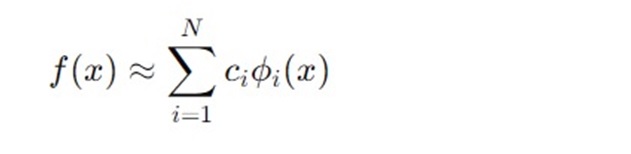
In collocation methods, the solution is represented as a linear combination of basis functions, often chosen from special functions like Legendre polynomials or Chebyshev polynomials.
Quadrature Methods
Quadrature methods replace the integral with a weighted sum: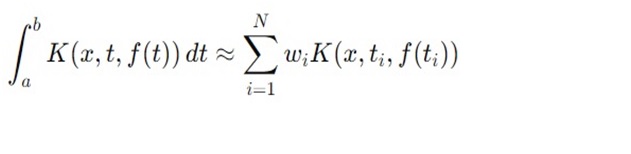
Special functions are used in Gaussian quadrature rules to calculate weights and nodes, ensuring high precision.
Galerkin Methods
Galerkin methods involve projecting the integral equation onto a subspace spanned by special functions, such as Bessel or Legendre polynomials. This reduces the problem to solving a finite-dimensional system.
Special functions offer a flexible toolset for solving nonlinear integral equations, both analytically, approximately, and numerically. Some of their properties, such as orthogonality, recurrence relations, and asymptotic expansions, significantly simplify complex calculations and provide efficient computation. By incorporating these functions into solution methods, researchers can tackle a wide range of problems in physics, engineering, and applied mathematics.
Applications of Special Functions in Nonlinear Integral Equations
Special functions have vast applications in the solution of nonlinear integral equations (NIEs) in many scientific and engineering disciplines. Their specific properties such as orthogonality, recurrence relations, and explicit representations make them very necessary in solving complicated real problems. This section examines some important applications of special functions in the solution of NIEs.
Physics and Engineering
Wave Propagation and Vibrations
Special functions like Bessel functions, Legendre polynomials, and spherical harmonics appear quite often in wave and vibration problems. These functions solve NIEs describing wave diffraction, acoustic wave propagation, and structural vibrations.
Example: In cylindrical or spherical coordinates, the kernel of the integral equation describing wave propagation often contains Bessel functions or spherical harmonics, for example: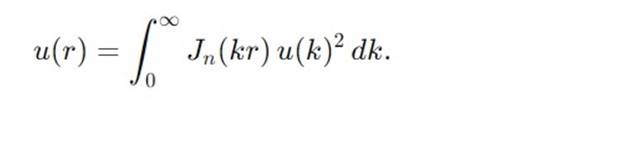
Electromagnetic Field Theory
NIEs describe scattering, radiation, and diffraction in electromagnetic systems. Special functions, particularly the Hypergeometric function and its associated Legendre polynomials, are used in the solutions.
Example: Scattering kernels for dielectric spheres have involved Legendre polynomials.
Mathematical Biology
Population Dynamics
The model interactions in populations, such as predator-prey systems or epidemics, use special functions such as Gamma functions and Hypergeometric functions to simplify analysis in nonlinear growth rates and feedback mechanisms.
Example: The equation is
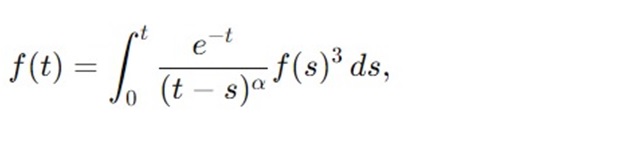
with Gamma functions in the kernel that are used to capture memory effects in population dynamics.
Neural Networks
Integral equations are applied to model signal propagation in biological neural networks. Sigmoid functions and other special functions are used to approximate nonlinear activation and synaptic weight kernels.
Fluid Mechanics
Boundary Layer Theory
NIEs explain the behavior of flow in boundary layers. Airy functions and Bessel functions are used to solve equations that model flow near surfaces.
Example: The Blasius equation, a model of laminar flow, can be written and solved in terms of Airy functions.
Heat and Mass Transfer Integral equations that describe heat conduction in anisotropic media involve kernels in the form of special functions such as Hypergeometric functions and Legendre polynomials.
Quantum Mechanics
Solutions to the Schrödinger Equation
In quantum mechanics, the NIEs appear in solutions to the Schrödinger equation for systems containing non-local potentials. Special functions include parabolic cylinder functions and confluent Hypergeometric functions that render kernels in such equations much more manageable.
Example: Nonlinear interaction in quantum systems can be represented in the form
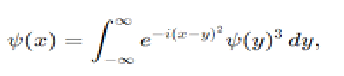
where the kernel contains Gaussian functions.
Scattering Problems
Scattering integral equations for particle interactions often make use of spherical harmonics and associated Legendre polynomials for angular dependencies.
Astrophysics
Stellar Structure and Dynamics
NIEs model stellar oscillations and energy transport. Special functions like polytropic functions and Bessel functions are used to solve such equations, providing insights into star formation and evolution.
Example:
The Lane-Emden equation modeling polytropic stars is very often stated in terms of special functions.
Gravitational Lensing
Integral equations governing the bending of light in gravitational lensing are written with kernels dependent on elliptic integrals or Hypergeometric functions.
Signal Processing and Control Theory
Nonlinear Filters
Integral equations in nonlinear filtering problems have sigmoid and wavelet functions as their components. These functions aid in the description of nonlinearity in signal processing algorithms.
Feedback Systems
In control theory, NIEs give the memory feedback system. Chebyshev and Legendre polynomials have orthogonal forms which make solving of these equations easier.
Materials Science
Crack Propagation
In fracture mechanics, integral equations have been used to model the stress distribution around cracks. Special functions Airy and Bessel have been applied to solve such equations. This enables researchers to predict material failure in advance.
Elasticity and Viscoelasticity
The kernels of integral equations representing material deformation under stress consist of special functions that accurately model elastic and viscoelastic behavior.
Economics and Finance
Option Pricing Models
NIEs are applied to price options and other financial derivatives. Kernels with special functions such as the Gamma function or Hypergeometric function are used to model nonlinear market dynamics.
Market Equilibrium Analysis
Special functions are used to simplify nonlinear feedback in economic systems in modeling supply-demand dynamics by integral equations.
Special functions find deep applications within the solving of NIEs from various disciplines. Their ability to represent complex phenomena accurately along with their much deeper theoretical foundation makes special functions a fundamental tool in all sciences both theoretical and practical. Researchers can address effective nonlinear systems of intricate complexity via the properties of special functions applied to better understand natural systems and engineered ones.
Challenges and Future Directions
Challenges:
- Complex Kernels: Nonlinear and oscillatory kernels are challenging to solve both analytically and numerically.
- Computational Load: Evaluating special functions for multi-dimensional or iterative problems is quite heavy on computers.
- Convergence Issues: Iterative schemes fail or converge slowly in many cases without an appropriate initial guess.
- High Dimensions: Extending solutions to higher dimensional NIEs becomes extremely difficult due to complexity.
- Non-Uniqueness: Finding meaningful solutions for multiple solutions is quite problematic.
Future Trends:
- Novel Special Functions: Develop new special functions particularly designed for particular NIEs and new emerging fields.
- Hybrid Techniques: Hybridize special functions with numerical and machine learning techniques to gain efficiency.
- Symbolic Computation: Improve automation of derivation of special functions.
- High Performance Computing: Solve large scale problems in a computationally efficient way with HPC.
- Fractional and Stochastic NIEs: Extend the use of special functions to fractional calculus and systems with randomness.
- Multiphysics Applications: Apply special functions to coupled systems such as fluid-structure interaction.
Conclusion
The study of nonlinear integral equations (NIEs) is a bastion of mathematical modeling which gives strong tools for understanding complex phenomena in different areas, such as physics, biology, engineering, or finance. Special functions occupy an important position in their solutions. These functions lead to analytical insight, easier numerical computations, and approximate solution for these equations. Their properties that are orthogonality, recurrence relations, and series expansion are especially suitable for the tough kernels and the non-linearity inherent in NIEs.
Throughout this research, we explored the theoretical foundations of NIEs, the significance of special functions, and their integration into various solution methods. Analytical techniques, such as transform methods and Green’s functions, leverage the explicit representations of special functions, while numerical methods, including collocation and Galerkin approaches, utilize them for efficient computation. The applications of special functions in solving NIEs range across many domains, from wave propagation and population dynamics to quantum mechanics and fluid mechanics, thus making them versatile and important.
Despite these successes, further challenges include the complexity of nonlinear kernels, computational inefficiencies, and difficulties handling high-dimensional or stochastic systems. New directions in this research emphasize the development of special functions, hybrid analytical-numerical techniques, and the possible integration of machine learning and traditional methods. Advances in computing and symbolic computation tools would also play a key role in overcoming current limitations.
Special functions have emerged as essential tools for solving nonlinear integral equations and serve as a pathway for theoretical insights and practical applications. This area of study continues to grow, challenging problems in current applications, extending its scope in the applications of various systems that are governed by NIEs.
Thus, with regard to these challenges, the future research is bound to unlock the entire potential of special functions for the solution of nonlinear integral equations.
References:
- Abramowitz, M., &Stegun, I. A. (1965). Handbook of mathematical functions with formulas, graphs, and mathematical tables,55. Dover Publications
- Andrews, L. C., &Phillips, R. L. (2003). Special functions of mathematics for engineers. SPIE Press.
- Arfken, G. B., Weber, H. J., &Harris, F. E. (2012). Mathematical methods for physicists: A comprehensive guide (7th ed.). Elsevier.
- Bateman, H., &Erdélyi, A. (1953). Higher transcendental functions,1. McGraw-Hill.
- Bellman, R., &Kalaba, R. E. (1965). Nonlinear differential equations. Academic Press.
- Bender, C. M., &Orszag, S. A. (1999). Advanced mathematical methods for scientists and engineers I: Asymptotic methods and perturbation theory. Springer.
- Boyce, W. E., &DiPrima, R. C. (2017). Elementary differential equations and boundary value problems (11th ed.). Wiley.
- Carrier, G. F., Krook, M., &Pearson, C. E. (2005). Functions of a complex variable: Theory and technique. Society for Industrial and Applied Mathematics (Society of Indian Automobile Manufacturers). https://doi.org/10.1137/1.9780898719116
- Debnath, L., &Mikusiński, P. (2005). Introduction to Hilbert spaces with applications (3rd ed.). Elsevier.
- Durán, A., &de la Iglesia, M. D. (2014). Orthogonal polynomials and integrable systems. Transactions of the American Mathematical Society, 366(10), 6039–6070.
- Elsgolts, L. (1977). Differential equations and the calculus of variations. MIR Publishers.
- Gradshteyn, I. S., &Ryzhik, I. M. (2014).series, and products (8th ed., D. Zwillinger & V. Moll, Eds.). Academic Press. Table of integrals.
- Kammerer, A., &Masmoudi, N. (2007). Nonlinear integral equations in fluid dynamics. Communications in Partial Differential Equations, 32(8), 1201–1224.
- Kress, R. (1999). Linear integral equations (2nd ed.). Springer. https://doi.org/10.1007/978-1-4612-0559-3
- Lax, P. D. (2002). Functional analysis. John Wiley& Sons.
- Magnus, W., Oberhettinger, F., &Soni, R. P. (1966). Formulas and theorems for the special functions of mathematical physics. Springer
- Miller, K. S. (1971). An introduction to the calculus of finite differences and difference equations. Dover Publications.
- Olver, F. W. J., Lozier, D. W., Boisvert, R. F., &Clark, C. W. (2010). NIST handbook of mathematical functions. Cambridge University Press.
- Polyanin, , &Manzhirov, A. V. (2008). Handbook of integral equations (2nd ed.). Chapman & Hall/CRC. https://doi.org/10.1201/9781420010558
- Prüss, J., &Simonett, G. (2016). Moving interfaces and quasilinear parabolic evolution equations. Birkhäuser.
- Rainville, E. D. (1960). Special functions. Macmillan.
- Sneddon, I. N. (1957). Elements of partial differential equations. McGraw-Hill.
- Stakgold, I., &Holst, M. J. (2011). Green’s functions and boundary value problems (3rd ed.). John Wiley& Sons.
- Tricomi, F. G. (1957). Integral equations. Dover Publications.
- Watson, G. N. (1944). A treatise on the theory of Bessel functions (2nd ed.). Cambridge University Press.
- Pooja, & Jakhar, M. S. (2024). Mathematical Formulation of Modern Algebra Field Concepts. International Journal of Applied and Behavioural Sciences, 1(1), 29–37. https://doi.org/10.70388/ijabs24704
- Pritee, & Jakhar, M. S. (2024). Polynomials Belonging To Galois Group And It’s Solvability Problems. International Journal of Applied and Behavioural Sciences, 1(1), 45–56. https://doi.org/10.70388/ijabs24706
- Anju, A., & Jakhar, M. S. (2024). Investigating algebraic simple groups with conjugacy classes and products. Edumania-An International Multidisciplinary Journal, 02(04), 329–335. https://doi.org/10.59231/edumania/9092
Statements & Declarations:
Peer-Review Method
This article underwent double-blind peer review by two external reviewers.
Competing Interests
The author/s declare no competing interests.
Funding
This research received no external funding.
Data Availability
Data are available from the corresponding author on reasonable request.
Licence
The Role of Special Functions in the Solution of Nonlinear Integral Equations © 2025 by Samriti and Manjeet Singh Jakhar is licensed under CC BY-NC-ND 4.0. Published by IJABS.