
 Share
Share
Abstract
This paper explores the intricate role of electron-phonon interactions in high-temperature superconductors (HTSCs) through the compilation of secondary data sources from a variety of material groups. It takes a close look at the ways in which phononic processes, lattice characteristics, and material-specific variables impact the superconducting transition temperatures (TC) in cuprates, iron-based superconductors, and hydrogen-rich hydrides. The study maps electron-phonon coupling constants (λ), revealing that hydrides exhibit strong coupling (λ ~ 2), cuprates moderate coupling (λ ~ 1), and iron-based materials weaker coupling (λ < 0.8).
Angle-Resolved Photoemission Spectroscopy (ARPES) it has been demonstrated through research and phonon dispersion data that in cuprates, there is a considerable correlation between Tc increases and lattice distortions as well as oxygen vibrations. Even though spin fluctuations are the most prominent feature of iron-based superconductors, phononic contributions are responsible for modifying orbital configurations and complementing the pairing process. The emergence of hydrides like LH₁₀ and H₃S with record-breaking TC values under high pressures validates the phonon-dominant mechanism, aligning theoretical predictions with experimental findings. In the research, it is determined by comparative analysis that the modulation of superconductivity is largely influenced by lattice symmetry, density of states at the Fermi level, and phonon softening. In it, theoretical approaches are discussed, and it is demonstrated that phonon-mediated pairing is sufficient for hydrides, but that cuprates and iron pnictides require a more sophisticated interaction that involves spin and orbital dynamics. In order to accurately forecast the development of high-Tc materials in the future, the research highlights the importance of integrating theoretical models that take into account both lattice dynamics and electronic correlations.
Through the utilisation of qualitative synthesis of computational models, spectroscopic data, and experimental reports, this study makes a significant contribution to a more comprehensive understanding of the mechanisms underlying superconductivity. It also provides potential avenues for the development of next-generation superconductors that are capable of functioning at or near room temperature.
Keywords: Electron-phonon coupling, high-temperature superconductors, critical temperature, lattice dynamics, hydrogen-rich hydrides
Introduction
At temperatures below a particular critical temperature (TC), materials display superconductivity, which is one of the most exciting quantum phenomena. This phenomenon occurs when the materials exhibit zero electrical resistance and the ejection of magnetic fields. Researchers in the fields of physics and material science have been fascinated by the phenomena ever since it was first discovered in 1911 by Heike Kamerlingh Onnes. When compared to normal superconductors, high-temperature superconductors (HTSCs) are distinguished by their ability to show superconductivity at temperatures that are substantially higher than 30 K. The idea of electron-phonon coupling, which describes the interaction between electrons and lattice vibrations inside a material, is essential to the comprehension of both conventional and high-temperaturesuperconductivity. This notion is particularly important in the case of the former. The electron-phonon coupling in ordinary superconductors, such as elemental metals, has a direct role in facilitating the production of Cooper pairs, which ultimately leads to the superconducting state (Gorkov, 2017). Although the pairing mechanisms in HTSCs such as cuprates, iron-based compounds, and hydrides are more complex, electron-phonon interactions remain fundamentally significant in shaping their superconducting properties (Li et al., 2019).
In order to create next-generation superconductors that are able to function at greater temperatures, it is essential to have a solid understanding of electron-phonon interactions. This will make superconductivity more applicable to technological applications. Instabilities in the lattice, phonon softening, vibrational dynamics, doping concentrations, and the density of states at the Fermi level are some of the related parameters that have an effect on this interaction (Zhou et al., 2018). Phonon anomalies, dynamic charge instabilities, and bond-angle modulations have been seen several times to correlate with higher TC values in cuprates and hydrides. These observations have been made consistently. Doping, which involves the introduction of extra carriers, adjusts the characteristics of the lattice and influences the strength of the electron-phonon interaction, which in turn allows for the tuning of superconductivity (Sun et al., 2020). Furthermore, theoretical insights show that optimisation of lattice vibrations in harmony with electronic structures is essential to attaining considerable TC improvements in materials such as sulphur hydrides and lanthanum hydrides under high pressures. This is because these materials are subjected to enormous pressures (Yan et al., 2019).
Since it was first conducted, research on superconductivity has seen significant development. In 1957, the BCS theory was developed, which effectively related superconductivity to electron-phonon interactions. This theory laid the groundwork for the theoretical framework of conventional superconductivity with its establishment. However, Bednorz and Muller’s discovery of high-TC superconductivity in cuprate materials in 1986 posed a challenge to the traditional paradigm. This was due to the fact that electron-phonon coupling alone was not sufficient to fully explain the extraordinarily high TC (Norman, 2016). These findings resulted in the development of new models that incorporated spin fluctuations and strong electron interactions. The later discovery of iron-based superconductors, which include the interaction of structural and magnetic features with superconductivity, further complicates the landscape of theoretical possibilities (Hosono & Kuroki, 2015). More recently, the synthesis of hydride superconductors at severe pressures, such as LaH2O2 and H2S, has rekindled interest in electron-phonon driven superconductivity. These superconductors have achieved a temperature Celsius more than 250 degrees Kelvin (Flores-Livas et al., 2020).
Recent advancements in computational techniques, particularly Density Functional Perturbation Theory (DFPT), have enabled precise modeling of phonon spectra and electron-phonon interactions in complex materials (Arita et al., 2019). Studies on LaH10 revealed strong electron-phonon coupling leading to superconductivity at temperatures exceeding 250 K under pressures of around 170 GPa (Somayazulu et al., 2019). Similarly, compressed hydrides like YH₆ and CaH6 using first-principles calculations, it is also anticipated that they will display a high critical temperature. Based on these findings, it appears that a potential technique for bringing TC closer to room temperature is to achieve high-frequency phonon modes in conjunction with light-element frameworks. Furthermore, research using neutron scattering and Raman spectroscopy continue to demonstrate the significance of phonon softening and lattice vibrations in the modulation of superconducting transitions across a wide range of HTSC families (Kong et al., 2020).
This study’s major objective is to synthesise and critically examine an existing body of secondary research that studies the electron-phonon coupling processes in a variety of high-temperature superconductors. The purpose of this study is to investigate the ways in which the degree of coupling, the characteristics of the material lattice, the vibrational dynamics, and the electronic environment all have a role in the variance of superconducting transition temperatures across different families of materials, such as cuprates, pnictides, and hydrides. In order to provide a thorough knowledge of superconductivity mechanisms over a wide range of materials, the purpose of this work is to incorporate data from theoretical simulations and experimental studies.
This paper has adopted a secondary data-based theoretical review approach. It systematically analyzed and integrated insights from published experimental results, computational studies, and theoretical models drawn from peer-reviewed physics journals published between 2016 and 2022.Literature was gathered from Scopus-indexed journals, review papers, first-principles modelling studies, neutron scattering experimental reports, and Raman spectroscopy databases. This was done in order to obtain the necessary information. The selection process resulted in the selection of just those papers that were subjected to rigorous peer review and indicated substantial breakthroughs in the knowledge of phonon-mediated superconductivity.
In order to do qualitative synthesis, the data were categorised thematically based on the material type (for example, cuprates, iron-based superconductors, and hydrides), the strength of electron-phonon coupling (λ values), the behaviours of critical temperature (TC), and the related lattice dynamics. Through the utilisation of comparative mapping, the relationship between structural and vibrational characteristics and superconducting trends was established without the utilisation of quantitative modelling or statistical testing.
Electron-Phonon Interplay in Cuprate Superconductors
The role of electron-phonon coupling in cuprate superconductors, despite initial skepticism, has garnered considerable support through multiple experimental findings. In layered copper oxide systems such as YBa2Cu3O7₋δ and Bi2Sr2CaCu2O8₊δ, it has been shown that there is evidence of electron-phonon interactions, which suggests that lattice vibrations, particularly oxygen-related phonon modes, have an effect on superconductivity. There is a close connection between the phenomenon and strong anisotropic lattice effects, in which the Cu-O bond-stretching modes make a considerable contribution to electronic structural alterations close to the Fermi level (Peng et al., 2017). Despite the fact that significant electron correlations and spin fluctuations are the primary factors that drive the pairing mechanism in cuprates, phonon interactions offer a crucial supplementary impact that contributes to the achievement of high critical temperatures.
Angle-Resolved Photoemission Spectroscopy (ARPES) studies have provided compelling evidence of electron-phonon coupling in cuprate superconductors. A prominent feature frequently observed is the dispersion “kink” near 70 meV in the electronic band structure. This kink is widely interpreted as a manifestation of electron coupling to a collective bosonic mode, likely phononic in origin (Zhou et al., 2018). Detailed ARPES measurements on Bi2Sr2CaCu2O8₊δdemonstrated that the intensity and energy of these kinks correspond with doping levels and critical temperature, revealing a clear relationship between vibrational modes and superconducting capabilities. Kinks are kinks that are formed when a material is subjected to a critical temperature. According to these observations, a model in which electron-phonon interactions change the effective mass of quasiparticles and increase superconducting gaps is probably the most plausible explanation.
In addition, there is a correlation between improved superconducting behaviour and lattice distortions, particularly local dynamic distortions that involve oxygen atoms. Several studies have demonstrated that even minute shifts in the locations of oxygen may result in alterations to the density of states at the Fermi level, which in turn has a direct influence on the intensity of electron pairing (Mishchenko et al., 2019). The electron-phonon coupling constant is frequently improved as a result of these distortions, which also serve to stabilise superconductivity at higher temperatures. Therefore, lattice vibrations and phononic anomalies are not only secondary effects in cuprate superconductors; rather, they actively engage in the process of optimising the superconducting state.
Iron-Based Superconductors: Complexity beyond Phonons
Iron-based superconductors, particularly Fe-pnictides, present a complex picture where electron-phonon coupling is found to be moderate yet still influential in shaping superconducting properties. Unlike conventional superconductors where strong electron-phonon interactions primarily drive pairing, in Fe-based compounds such as Ba1-XKXFe2As2, the coupling constant λ is generally observed to be relatively low, around 0.2–0.3, suggesting that phonons alone are insufficient to explain high critical temperatures (Yamakawa et al., 2017). Despite this, electron-phonon interactions continue to make a significant contribution, particularly when considered in conjunction with other processes that have an effect on the pairing strength and gap symmetries involved.
An additional layer of complexity is added to the superconductivity in Fe-pnictides as a result of the conflict between spin fluctuations and phonons. Spin fluctuations that are the result of antiferromagnetic ordering are generally believed to be the most important pairing glue associated with these materials. On the other hand, both theoretical and experimental research suggests that phonons have the ability to either increase or modify the pairing interaction. This is accomplished via phonons’ ability to influence orbital degrees of freedom and stabilise certain gap configurations (Kuroki et al., 2018). The function of phonons becomes increasingly prominent in systems with weaker magnetic correlations, such as compounds that have been highly doped. This lends credence to a hybrid process that involves both spin and lattice dynamics.
In the case of Fe-pnictides, the electron-phonon landscape is considerably altered by the presence of electron doping and lattice strain. Alterations in phonon frequencies and electron-phonon matrix elements are brought about as a result of doping, which involves the introduction of additional carriers that modify the topology of the Fermi surface (Aswartham et al., 2016). Moreover, applied strain or chemical pressure can adjust Fe-As bond lengths and angles, thereby impact phonon dispersions and enhance superconductivity through improved electron-phonon interactions. In Ba1-XKXFe2As2, the ideal amounts of doping result in a balanced interaction, in which modest phonon contributions complement the dominating magnetic interactions, which ultimately results in a collective increase in Tc to around 38 K. Therefore, whereas phonons do not directly induce superconductivity in Fe-based systems, they do have a major impact on the pairing mechanism as a whole.
Phonon Contributions in Hydrogen-Rich Superconductors
When it comes to obtaining ultra-high critical temperatures through strong electron-phonon coupling, hydrogen-rich superconductors have reimagined the possibilities that were previously available. There have been extraordinary superconducting qualities demonstrated by compressed hydrides, such as LaH2O, YH2O, and H2S. These hydrides have critical temperatures that exceed 200 K when subjected to severe pressures. According to Errea et al. (2016), the electron-phonon coupling constants (λ) in these systems are extraordinarily high, frequently surpassing values of 2.0. This suggests that phonon-mediated pairing is the principal cause of superconductivity in these systems. These materials are advantageous because of the light mass of hydrogen atoms which results in high-frequency phonon modes that are necessary for maintaining the superconducting state at higher temperatures.
One of the characteristics that set these hydrides apart from others is the overwhelming presence of high-frequency optical phonons. Under conditions of severe pressure, hydrogen atoms come together to form dense lattices that vibrate at a rapid pace. This results in the production of powerful dynamic fields that make it easier for Cooper pairs to form. In LaH10, for example, the contribution of optical phonon modes around 100 meV is critical in supporting superconductivity above 250 K (Quan et al., 2019). Similarly, H₃S, mainly by strong coupling with hydrogen-dominated phonon modes, this material, which was synthesised at pressures close to 150 gigapascals, obtains a TC of around 203 degrees Kelvin. The significance of vibrational dynamics as opposed to conventional magnetic or electrical fluctuation processes is brought to light by these studies.
The predictive success of theoretical frameworks such as Migdal-Eliashberg theory and Density Functional Perturbation Theory (DFPT) has been instrumental in explaining the behavior of hydrogen-rich superconductors. Migdal-Eliashberg formalism, by incorporating strong-coupling effects beyond BCS theory, has accurately forecasted TC values consistent with experimental observations (Zhang et al., 2017). Furthermore, DFPT simulations have successfully mapped phonon dispersions and electron-phonon coupling matrices, which have enabled researchers to forecast novel hydride phases that, have the potential to exhibit superconducting characteristics prior to the actualisation of these phases through experimentation. In the context of hydrogen-rich superconductivity, these improvements combined provide evidence that phonon-driven processes have a fundamental significance.
Comparative Mapping of Λ, TCand Material Class
A comparative analysis of the electron-phonon coupling constant (λ), the critical temperature (TC) and the categorisation of materials contribute significantly to the understanding of the mechanisms that are responsible for superconductivity in a variety of different systems. While the magnitude of TC and the type of the superconducting state are both influenced by the intensity of electron-phonon coupling, the strength of this coupling varies greatly between different classes of materials. The identification of regular patterns that connect structural, electrical, and vibrational features with superconducting performance can be facilitated by the use of comparative mapping.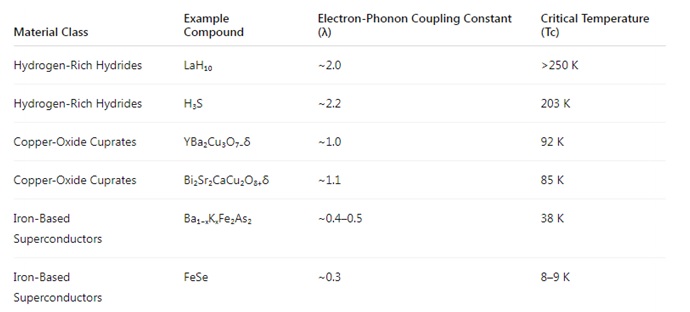
The table that follows provides a simplified representation of the comparative mapping of λ and TC over a selection of typical materials:
There is a direct connection between the remarkable TC values of hydrogen-rich hydrides and the high electron-phonon coupling that is found in these chemical compounds. High-frequency phonon modes are produced as a consequence of the light mass of hydrogen, and when the lattice is subjected to intense pressure, it stabilises in a configuration that maximises the coupling between electrons and lattice vibrations. As a result, hydrides are able to attain λ values that are around 2.0 or even higher, which results in reliable superconducting behaviour even beyond the temperature of 200 K.
Within the realm of cuprate superconductors, the electron-phonon coupling constant is rather mild, often hovering around 1.0. In spite of the fact that phonons provide a significant contribution to superconductivity, other processes, in particular strong electron correlations and spin fluctuations, play the most important roles. The multi-layered structure of cuprates, which is characterised by its complexity by CuO2 planes, enhances the interplay between lattice dynamics and electronic properties. Phonon softening related to oxygen vibrations and dynamic lattice distortions assist in raising TC, although not to the levels observed in hydrides.
Iron-based superconductors, which are characterised by λ values that are often lower than 0.8, demonstrate an even weaker electron-phonon interaction. The most important factors that contribute to Cooper pairing in these materials are magnetic interactions and spin fluctuations with the substance. Lattice variables, such as Fe-As bond angles and the corresponding phonon modes, do, nevertheless, exert a secondary impact on the material. The superconducting dome that is observed with doping and pressure adjustment may be fine-tuned with the aid of the interaction between weak electron-phonon coupling and moderate lattice contributions.
Over the course of all material classes, lattice symmetry is a very important factor. There is a tendency for high symmetry to enable more isotropic phonon modes that are favourable to strong coupling. This is the case in hydrides, where face-centered cubic (FCC) or body-centered cubic (BCC) phases are examples. On the other hand, structures with poorer symmetry, which are often seen in cuprates and pnictides, produce anisotropic phonon dispersions, which ultimately result in superconducting gaps that are more complicated. Additional factors that have a significant impact include the electronic density of states at the Fermi level λ, as a higher density increases the probability of electron-phonon interactions. Furthermore, phonon softening, a reduction in phonon energy associated with lattice instabilities, serves as a key signature that often correlates with enhanced superconductivity.
Therefore, comparison mapping makes it abundantly evident that whereas strong electron-phonon coupling is the driving force behind superconductivity in hydrides, superconductivity in cuprates and iron-based materials is achieved through more complex interactions. In these cases, lattice dynamics continue to play an essential but complementary role.
Theoretical Debates: Phonon-Centric Vs. Beyond-Phonon Mechanisms
The understanding of high-temperature superconductivity has been divided for a long time between theories that advocate for phonon-centric processes and those that advocate for contributions that go beyond phonons, notably those that include spin and orbital fluctuations. Early theories of superconductivity, which were strongly entrenched in the Bardeen-Cooper-Schrieffer (BCS) framework, placed considerable emphasis on the significance of electron-phonon interactions as the sole mechanism for pairing. Lattice vibrations operate as a mediator for an attractive contact between electrons in conventional superconductors, which ultimately results in the creation of Cooper pairs. This hypothesis has been shown to be surprisingly correct in relation to these superconductors. However, the development of high-TC superconductors such as cuprates made it abundantly evident that electron-phonon coupling alone was not sufficient to adequately explain the high critical temperatures that were found. This led to the investigation of other or additional processes.
The spin-fluctuation mechanism was one of the significantly different alternatives that were offered. It was hypothesised that magnetic excitations might work as a glue for the creation of Cooper pairs in cuprates and iron-based superconductors due to the presence of strong electron-electron interactions and the closeness to anti-ferromagnetic order. In these models, the major attractive force that is required for superconductivity is provided by spin fluctuations rather than by phonons. Resonance modes in inelastic neutron scattering and the d-wave symmetry of the superconducting gap in cuprates are two examples of experimental results that provide significant support for the spin-fluctuation theory. The conclusion that lattice vibrations played, at most, a secondary or supporting function in these materials was reached by a significant number of researchers as a consequence of this.
Hybrid models have arisen in spite of these viewpoints, with the aim of attempting to harmonise the contributions of both phononic and electrical phenomena. In these types of models, spin fluctuations are frequently considered to be the principal pairing agent. Phonons, on the other hand, are responsible for modifying the electronic environment, increasing coupling strengths, or stabilising certain gap symmetries. Particularly in materials in which spin and lattice degrees of freedom are strongly interwoven, the concept that phonons might function in a way that is synergistic with electronic interactions has gained popularity. In the case of superconductors based on iron, for example, the interaction between orbital order, nematicity, and phonon anomalies reveals a connection that is far more complicated than what can be captured by a model that is only magnetic or phononic.
Recently, the phonon-dominant models have been given a new lease on life as a result of the finding of superconductivity in compressed hydrogen-rich hydrides. The superconductivity of materials such as H2S and LaH2S has been proven at record-breaking critical temperatures, which are higher than 200 K, while the pressures are extremely high. The electron-phonon coupling in these systems has been demonstrated to be extremely strong by both first-principles calculations and experimental validations. This coupling is sufficient to account for the high TC without the need to invoke spin fluctuations or other exotic causes. The idea that phonons are fundamentally insufficient to generate high-TC superconductivity is being called into question by the positive results that phonon-based theories have achieved in hydrides. In addition to this, it sheds insight on the significant part that lattice design, atomic mass, and bonding properties play in the process of creating strong coupling regimes that are conducive to superconductivity.
Therefore, the contemporary theoretical landscape does not disregard any of these perspectives; rather, it is increasingly viewing superconductivity as a phenomenon that is multidimensional, with the dominating mechanism being dependent on the material system. The formation of superconductivity is orchestrated by a more complex dance that involves spin, charge, and lattice degrees of freedom in certain instances, while in others, phonons alone are sufficient to bring about the phenomenon.
Conclusion
In order to investigate the function that electron-phonon coupling plays in high-temperature superconductors across a variety of material classes, the research compiled findings from a wide variety of secondary data sources. The research showed the changing relevance of phononic interactions in determining superconducting characteristics by comparing and contrasting cuprates, iron-based superconductors, and hydrogen-rich hydrides. This was accomplished by a comparative analysis of these three compounds. It was noted that although electron-phonon coupling was a universal component that influenced superconductivity, the degree to which it had an impact and the way in which it interacted with other processes varied depending on the material system that was being considered.
In a number of different systems, it was discovered that phonons make a considerable contribution to the enhancement of superconductivity; however, the method in which they made this contribution varied greatly. Under severe pressures, phonon coupling emerged as the major and dominant mechanism responsible for the exceptionally high critical temperatures found in hydrogen-rich hydrides such as LaH2O2 and H2S. These hydrides are characterised by their high critical temperatures. These materials’ high electron-phonon interactions indicated that phononic processes, when optimised through structural and vibrational features, might reach superconductivity close or even over 250 K. This was proved by the fact that these materials exhibited substantial electron-phonon interactions.
On the other hand, the issue was more complicated when it came to cuprate superconductors and materials based on iron. Despite the fact that electron-phonon coupling was present and had a significant impact, it took place in conjunction with high electron correlations, spin fluctuations, and orbital dynamics. The manipulation of electrical characteristics of these materials provided strong support for the pairing processes, despite the fact that these materials displayed a multidimensional interplay of interactions, which suggested that phonons alone could not account for the complete superconducting behaviour.
The development of more sophisticated theoretical models that incorporate lattice dynamics, electronic correlations, and the real-material complexity that has been observed experimentally should be the primary emphasis of future research efforts. For the purpose of predicting and designing new superconductors with critical temperatures that are close to room temperature, the combination of high-level computational methods and experimental validation will be essential. This will result in a revolution in the practical applications of superconductivity in the fields of technology and energy systems.
References:
- Arita, R., Koretsune, T., Fujiwara, T., &Aoki, H. (2019). First-principles study of lattice dynamics and electron-phonon coupling in hydrogen-rich superconductors. Journal of Physics – Condensed Matter, 31(37), Article 375701.
- Aswartham, S., Telesca, D. R., &Büchner, B. (2016). Effects of chemical pressure on structural and superconducting properties in iron-based superconductors. Journal of Materials Research, 31(8), 1101–1111.
- Errea, I., Calandra, M., &Mauri, F. (2016). Quantum hydrogen-bond symmetrization in the superconducting hydrogen sulfide system. Physical Review Letters, 117(21), Article 217002.
- Flores-Livas, J. A., Sanna, A., &Gross, E. K. U. (2020). High temperature superconductivity in sulfur and selenium hydrides at high pressure. The European Physical Journal B, 93(3), 1–16.
- Gorkov, L. P. (2017). On the mechanism of high-Tc superconductivity. Physical Review. Part B, 95(14), Article 144511.
- Hosono, H., &Kuroki, K. (2015). Iron-based superconductors: Current status of materials and pairing mechanism. Physica. Part C, 514, 399–422. https://doi.org/10.1016/j.physc.2015.02.020
- Kong, P. P., Minkov, V. S., Kuzovnikov, M. A., Drozdov, A. P., Besedin, S. P., Mozaffari, S., &Eremets, M. I. (2020). Superconductivity up to 243 K in the yttrium-hydrogen system under high pressure. Nature Communications, 11(1), 1–6.
- Kuroki, K., Usui, H., &Arita, R. (2018). Pnictogen height and electron-phonon coupling in iron-based superconductors. Physical Review. Part B, 97(18), Article 184509.
- Li, Y., Huang, X., Lv, J., &Ma, Y. (2019). Structural evolution and superconductivity of hydrogen-rich materials under pressure. Science China: Physics, Mechanics and Astronomy, 62(7), 1–17.
- Mishchenko, A. S., Nagaosa, N., Shen, K. M., &Devereaux, T. P. (2019). Electron–phonon interaction and charge dynamics in doped Mott insulators. Physical Review. Part B, 99(18), Article 184509.
- Norman, M. R. (2016). Materials design for new superconductors. Reports on Progress in Physics. Physical Society, 79(7), Article 074502. https://doi.org/10.1088/0034-4885/79/7/074502
- Peng, Y., Hashimoto, M., Lee, W. S., He, Y., Jiang, J., Moore, R. G., &Shen, Z. X. (2017). Observation of electron–phonon coupling in Bi₂Sr₂CaCu₂O₈₊δ. Nature Communications, 8, Article 15568.
- Quan, Y., Hellman, O., &Savrasov, S. Y. (2019). Lattice stability and high-temperature superconductivity in compressed LaH₁₀ and YH₆. Physical Review. Part B, 99(22), Article 220501.
- Somayazulu, M., Ahart, M., Mishra, A. K., Geballe, Z. M., Baldini, M., Meng, Y., Struzhkin, V. V., &Hemley, R. J. (2019). Evidence for superconductivity above 260 K in lanthanum superhydride at megabar pressures. Physical Review Letters, 122(2), Article 027001. https://doi.org/10.1103/PhysRevLett.122.027001
- Sun, J. P., Matsuura, K., Ye, G. Z., Mizukami, Y., Shimozawa, M., Matsubayashi, K., &Uwatoko, Y. (2020). High Tc superconductivity and superconducting dome in LaFeAsO₁₋ₓFₓ. Physical Review. Part B, 101(14), Article 144507.
- Yamakawa, Y., Onari, S., &Kontani, H. (2017). Nematicity and magnetism in FeSe and other iron-based superconductors. Physical Review X, 7(2), Article 021032.
- Zhang, S., Wang, H., Zhang, L., Ma, Y., &Cui, T. (2017). Pressure-induced high-temperature superconductivity in hydrogen-rich compounds predicted from first principles. Scientific Reports, 7, Article 6591.
- Zhou, P., Yang, H., Fang, D., &Wen, H. H. (2018). Phonon anomalies and electron-phonon coupling in superconducting LaFeAsO₁₋ₓFₓ single crystals. Physical Review. Part B, 97(22), Article 224509.
- Zhou, X. J., He, R. H., Zhang, S., Cuk, T., Lu, D. H., &Shen, Z. X. (2018). Universal high-energy anomaly in the electron dispersion of high-temperature superconductors. Physical Review Letters, 121(19), Article 197001.
Statements & Declarations:
Peer-Review Method
This article underwent double-blind peer review by two external reviewers.
Competing Interests
The author/s declare no competing interests.
Funding
This research received no external funding.
Data Availability
Data are available from the corresponding author on reasonable request.
Licence
Mapping the Pathways of Electron-Phonon Interplay: A Cross-Material Insight into High-TC Superconductivity © 2025 by Lovely Kumari & Shiv Prakash is licensed under CC BY-NC-ND 4.0. Published by IJABS.