
 Share
Share
Abstract
Polymeric nanoparticles (PNPs) are an increasingly important platform to deliver bioactive phytochemicals from traditional and herbal medicines. Nanosizing and polymeric encapsulation improve the aqueous solubility, chemical stability, and oral or topical bioavailability of poorly soluble natural products while enabling sustained and stimulus-responsive release profiles. This review summarizes fabrication strategies for herbal-actives-loaded PNPs (emulsion–diffusion, nanoprecipitation, ionic gelation, polyelectrolyte complexation), highlights commonly used synthetic and natural polymers (PLGA, PLA, PCL, chitosan, alginate), and compares design choices for oral, topical, and parenteral delivery. We synthesize recent in vitro and in vivo evidence for improved pharmacokinetics and therapeutic outcomes – with curcumin, berberine, and other phytoconstituents as paradigmatic examples – and examine applications in wound healing, anti-inflammatory therapy, cancer adjuvant therapy, and antimicrobial uses. Critical issues – scalable manufacturing, reproducibility, batch-to-batch variability of herbal extracts, toxicity, and regulatory pathways – are discussed. Finally, we propose best-practice guidelines for characterization (size, zeta potential, release kinetics), preclinical testing, and a translational roadmap to clinic. The review concludes by identifying knowledge gaps and future directions where PNPs can responsibly modernize herbal therapeutics.
Keywords: Polymeric nanoparticles; herbal actives; controlled release; phytochemicals; PLGA; chitosan; nanoencapsulation.
Introduction
Herbal medicine has been an integral part of healthcare systems for centuries, providing therapeutic agents that are often safer, more biocompatible, and cost-effective than synthetic drugs [1–3]. Despite their extensive pharmacological potential, many herbal bioactives—such as curcumin, silymarin, resveratrol, and quercetin—suffer from limitations including poor aqueous solubility, low permeability, rapid metabolism, and instability in physiological environments [4–6]. These drawbacks lead to poor systemic bioavailability, inconsistent therapeutic outcomes, and challenges in clinical translation. Nanotechnology-based delivery systems, particularly polymeric nanoparticles (PNPs), have emerged as promising strategies to overcome these limitations and to enhance the therapeutic efficacy of plant-derived compounds [7–9]
Polymeric nanoparticles are colloidal carriers typically ranging from 10 to 1000 nm in diameter, composed of biocompatible and biodegradable polymers such as poly (lactic-co-glycolic acid) (PLGA), polycaprolactone (PCL), chitosan, and alginate [10–12]. These nanocarriers can encapsulate both hydrophilic and hydrophobic compounds, offering controlled release, site-specific delivery, and protection of the encapsulated drug from degradation [13–15]. Depending on their architecture, PNPs can be classified as nanospheres, in which the drug is uniformly distributed within the polymer matrix, or nano capsules, where the drug resides in a reservoir core surrounded by a polymeric shell [16, 17]. Such structural versatility enables precise control over drug-loading efficiency and release kinetics.
In the context of herbal therapeutics, PNPs have demonstrated substantial potential. For instance, curcumin-loaded PLGA nanoparticles exhibit prolonged circulation time and improved anticancer activity compared to free curcumin [18, 19]. Similarly, silymarin and catechin encapsulated in chitosan nanoparticles display enhanced hepatoprotective and antioxidant effects, respectively [20, 21]. The controlled release behavior of these nanocarriers minimizes dosing frequency and reduces adverse effects by maintaining plasma drug levels within the therapeutic window [22].
Recent advances in polymer chemistry have led to the development of stimuli-responsive nanoparticles that release herbal actives in response to environmental triggers such as pH, temperature, or enzymatic activity [23–25]. These “smart” delivery systems have opened new avenues for targeted therapy in diseases such as cancer, diabetes, and neurodegenerative disorders [26, 27]. Despite encouraging progress, challenges remain related to large-scale synthesis, stability, regulatory approval, and toxicity assessment of herbal PNPs [28–30]. This review provides an updated overview of polymeric nanoparticles for controlled release of herbal actives, encompassing polymer selection, fabrication methods, release mechanisms, characterization techniques, biomedical applications, and future research directions.
Classification and Types of Polymeric Nanoparticles
Polymeric nanoparticles (PNPs) are broadly classified into nanospheres and nano capsules according to their structural configuration and drug distribution [11].
Nanospheres are matrix systems in which the drug is uniformly dispersed throughout the polymer network, whereas nano capsules consist of a core–shell structure enclosing the active compound within a reservoir surrounded by a polymeric membrane [12]. Based on polymer origin, PNPs are further divided into natural polymer-based systems such as chitosan, alginate, gelatin, and dextran, and synthetic polymer-based systems including PLGA, PCL, PEG, and PLA [13, 14]. This classification profoundly influences physicochemical characteristics, degradation rate, encapsulation efficiency, and release kinetics, enabling precise modulation of drug delivery for specific biomedical applications [15].
Natural and Synthetic Polymers
PNPs can be fabricated using either natural polymers (e.g., chitosan, alginate, gelatin, dextran) or synthetic biodegradable polymers (e.g., PLGA, PCL, PEG, and PLA) [14, 16].
Natural polymers are generally biocompatible and non-toxic, while synthetic polymers provide precise control over degradation rate and release kinetics [17].
Methods of Preparation of Polymeric Nanoparticles
Several techniques have been developed for the fabrication of polymeric nanoparticles. The method chosen greatly affects particle size, encapsulation efficiency and drug release profile [22–25].
Emulsion Solvent Evaporation
A widely used method, especially for hydrophobic herbal actives. The polymer and drug are dissolved in a volatile organic solvent and emulsified in an aqueous phase containing a stabilizer such as polyvinyl alcohol (PVA). The solvent is then evaporated, resulting in nanoparticle formation [23].
Nanoprecipitation
In this simple and reproducible method, the polymer and drug are dissolved in a solvent and added dropwise into a non-solvent (usually water). The difference in solubility causes precipitation of nanoparticles [24].
Ionic Gelation and Coacervation
This method is used mainly for natural polymers such as chitosan and alginate. The formation of nanoparticles occurs due to electrostatic interactions between oppositely charged species [20, 21].
Spray Drying and Supercritical Fluid Techniques
These techniques are suitable for large-scale production and allow control over particle morphology and stability [37].
Encapsulation of Herbal Actives and Loading Efficiency
The encapsulation of herbal actives within polymeric nanoparticles offers several advantages: protection from degradation, improved solubility, and enhanced bioavailability [11–13].
Encapsulation efficiency (EE %) depends on polymer–drug compatibility, solvent polarity, and method of preparation. For example, curcumin-loaded PLGA nanoparticles exhibit an EE% exceeding 80%, while catechin-loaded chitosan nanoparticles reach up to 70% [18–21].
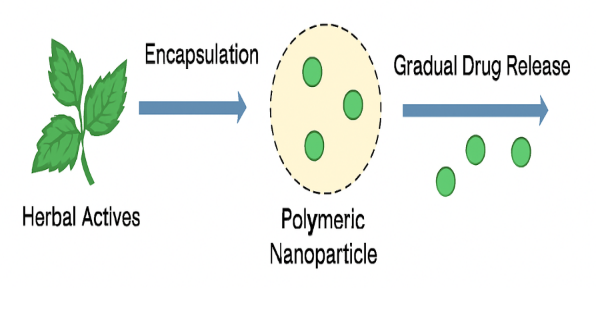
Figure 1: Schematic diagram showing encapsulation of herbal actives inside polymeric nanoparticles and gradual drug release from the matrix.
Drug Release Mechanisms and Kinetics
Controlled release from polymeric nanoparticles typically follows diffusion, erosion, or a combination of both mechanisms [22, 25].
Drug release can occur in three distinct stages:
- Initial burst release — from surface-adsorbed molecules.
- Sustained release phase — via diffusion through the polymer matrix.
- Terminal phase — governed by polymer degradation and erosion [26, 27].
Characterization Techniques
Accurate characterization of nanoparticles is critical to understanding their behavior in biological systems [33, 34].
| Technique | Parameter Measured | Instrument | Outcome |
| Dynamic Light Scattering (DLS) | Particle size, zeta potential | Malvern Zetasizer | Size distribution |
| SEM/TEM | Morphology, structure | Electron microscope | Particle shape and Size |
| FTIR | Functional group interactions | FTIR spectrometer | Polymer–drug bonding |
| DSC/TGA | Thermal stability | Thermal analyzer | Melting and degradation |
| XRD | Crystallinity | Diffractometer | Amorphous/crystalline nature |
Surface charge (zeta potential) also influences nanoparticle stability and bio-distribution. Typically, values greater than ±30 mV ensure colloidal stability [35, 36].
Biomedical Applications of Herbal Polymeric Nanoparticles
Polymeric nanoparticles have been extensively investigated for delivering herbal actives in anticancer, antioxidant, anti-inflammatory, and neuroprotective therapies [8, 9, 30].
Curcumin–PLGA nanoparticles show improved cytotoxicity against breast and colon cancer cells [18].
Resveratrol-loaded nanoparticles exhibit enhanced antioxidant activity and neuroprotection in Alzheimer’s models [13].
Chitosan nanoparticles carrying silymarin improve hepatoprotection in liver injury models [20].
Stimuli-responsive polymeric systems (pH-sensitive or temperature-sensitive) have shown targeted drug delivery to tumor sites, enhancing therapeutic outcomes while minimizing side effects [26, 27, 28].
Challenges and Future Perspectives
Despite encouraging preclinical outcomes, several challenges limit clinical translation of herbal polymeric nanoparticles [37–39].
Scalability and reproducibility: Laboratory-scale methods are often unsuitable for industrial production.
Stability: Herbal compounds may undergo oxidation or hydrolysis during formulation and storage.
Regulatory hurdles: Lack of harmonized guidelines for herbal nanomedicines complicates approval processes.
Toxicological evaluation: Comprehensive long-term toxicity studies are needed to ensure safety.
Future work should focus on developing green synthesis approaches, biopolymer composites, and personalized nano formulations integrating herbal actives with precision medicine tools. The coupling of computational modeling with experimental design may also optimize release kinetics and formulation parameters [29, 31, and 32].
Conclusion
Polymeric nanoparticles (PNPs) have revolutionized the field of herbal drug delivery by offering enhanced solubility, protection from degradation, and sustained release of bioactives. Their ability to overcome the physicochemical and pharmacokinetic limitations of herbal compounds establishes them as a bridge between traditional phytotherapy and modern nanotechnology. Biodegradable polymers such as PLGA, chitosan, and alginate have proven particularly effective in achieving controlled and targeted release. However, challenges related to large-scale synthesis, stability, regulatory approval, and long-term toxicity still hinder clinical translation. Continued interdisciplinary research integrating materials science, pharmacology, and biomedical engineering will be crucial to develop next-generation “smart” herbal nanocarriers with tunable release profiles, site-specific targeting, and improved patient compliance. Ultimately, polymeric nanoparticle-based herbal formulations hold immense promise for transforming natural therapeutics into reliable, evidence-based nanomedicines.
Statements & Declarations:
Peer-Review Method: This article underwent double-blind peer review by two external reviewers.
Competing Interests: The author/s declare no competing interests.
Funding: This research received no external funding.
Data Availability: Data are available from the corresponding author on reasonable request.
Licence: Polymeric nanoparticles for controlled release of herbal actives: A Review © 2026 by Meena Devi is licensed under CC BY-NC-ND 4.0. Published by IJABS.
References:
- Alkushi, A. G., Elazab, S. T., Abdelfattah-Hassan, A., Mahfouz, H., Salem, G. A., Sheraiba, N. I., Mohamed, E. A. A., Attia, M. S., El-Shetry, E. S., Saleh, A. A., ElSawy, N. A., & Ibrahim, D.(2022). Multi-strain-probiotic-loaded nanoparticles reduced colon inflammation and orchestrated the expressions of tight junction, NLRP3 inflammasome and caspase-1 genes in DSS-induced colitis model. Pharmaceutics, 14(6), Article 1183. https://doi.org/10.3390/pharmaceutics14061183
- Alven, S., & Aderibigbe, B. A. (2020). Surface modificationof polyamides by gaseous plasma-review and scientific challenges. Polymers, 12(12), Article 3020. https://doi.org/10.3390/polym12123020
- Anand, P., Kunnumakkara, A. B., Newman, R. A., & Aggarwal, B. B.(2007). Bioavailability of curcumin: Problems and promises. Molecular Pharmaceutics, 4(6), 807–818. https://doi.org/10.1021/mp700113r
- Danaei, M., Dehghankhold, M., Ataei, S., Hasanzadeh Davarani, F., Javanmard, R., Dokhani, A., Khorasani, S., & Mozafari, M. R.(2018a). Impact of particle size and polydispersity index on the clinical applications of lipidic nanocarrier Pharmaceutics, 10(2), Article 57. https://doi.org/10.3390/pharmaceutics10020057
- Danaei, M.et al. (2018b). International Journal of Nanomedicine, 13, 7375–7390.
- Danhier, F., Ansorena, E., Silva, J. M., Coco, R., Le Breton, A., & Préat, V.(2012). PLGA-based nanoparticles: An overview of biomedical applications. Journal of Controlled Release, 161(2), 505–522. https://doi.org/10.1016/j.jconrel.2012.01.043
- Dwyer, D. S., Aamodt, E., Cohen, B., & Buttner, E. A.(2014). Drug elucidation: Invertebrate genetics sheds new light on the molecular targets of CNS drugs. Frontiers in Pharmacology, 5, Article 177. https://doi.org/10.3389/fphar.2014.00177
- Fan, Y., Lu, Y., Cheng, B., Wei, Y., Wei, Y., Piao, J., Li, F., & Zheng, H.(2022). Correlation between in vivo microdialysis pharmacokinetics and ex vivo permeation for sinomenine hydrochloride transferosomes with enhanced skin absorption. International Journal of Pharmaceutics, 621, Article 121789. https://doi.org/10.1016/j.ijpharm.2022.121789
- Freiberg, S., & Zhu, X. X. (2004). Polymer microspheres for controlled drug release. International Journal of Pharmaceutics, 282(1–2), 1–18. https://doi.org/10.1016/j.ijpharm.2004.04.013
- Goyal, A. K.et al. (2019). Nanomedicine, 14(5), 1623–1640.
- Gupta, P. K.et al. (2020). Mater SciEng C, 112, Article 110934.
- Jain, K. K. (2020). An overviewof drug delivery systems. Methods in Molecular Biology, 2059, 1–54. https://doi.org/10.1007/978-1-4939-9798-5_1
- Jamkhande, P. G., Ghule, N. W., Bamer, A. H., & Kalaskar, M. G.(2019). Metal nanoparticles synthesis: An overview on methods of preparation, advantages and disadvantages, and applications. Journal of Drug Delivery Science and Technology, 53, Article 101174. https://doi.org/10.1016/j.jddst.2019.101174
- Katuwavila, N. P.et al. (2016). Carbohydrate Polymers, 148, 255–262.
- Keck, C. M., & Müller, R. H. (2006). Drug nanocrystals of poorly soluble drugs produced by high pressure homogenisation. EuropeanJournal of Pharmaceutics and Biopharmaceutics, 62(1), 3–16. https://doi.org/10.1016/j.ejpb.2005.05.009
- Kesarwani, K., & Gupta, R. (2013). Journal of AdvancedPharmaceutical Technology and Research, 4(2), 83–90.
- Kesharwani, P.et al. (2019). European Journal of Pharmaceutics and Biopharmaceutics, 142, 29–41.
- Kumari, A., Yadav, S. K., & Yadav, S. C.(2010). Biodegradable polymeric nanoparticles based drug delivery systems. Colloids and Surfaces. B, Biointerfaces, 75(1), 1–18. https://doi.org/10.1016/j.colsurfb.2009.09.001
- Lohcharoenkal, W., Wang, L., Chen, Y. C., & Rojanasakul, Y.(2014). Protein nanoparticles as drug delivery carriers for cancer therapy. BioMed Research International, 2014, Article 180549. https://doi.org/10.1155/2014/180549
- Maji, R., Omolo, C. A., Jaglal, Y., Singh, S., Devnarain, N., Mocktar, C., & Govender, T.(2021). A transferosome-loaded bigel for enhanced transdermal delivery and antibacterial activity of vancomycin hydrochloride. International Journal of Pharmaceutics, 607, Article 120990. https://doi.org/10.1016/j.ijpharm.2021.120990
- Mohanty, C.et al. (2021). Drug Delivery and Translation Research, 11, 1224–1238.
- Mukherjee, S.et al. (2022). Current Drug Delivery, 19(3), 365–382.
- Mundargi, R. C., Babu, V. R., Rangaswamy, V., Patel, P., & Aminabhavi, T. M.(2008). Nano/micro technologies for delivering macromolecular therapeutics using poly (D,L-lactide-co-glycolide) and its derivatives. Journal of Controlled Release, 125(3), 193–209. https://doi.org/10.1016/j.jconrel.2007.09.013
- Nair, R. S.et al. (2023). Journal of Applied Polymer Science, 140(13), Article e53346.
- Patra, J. K., Das, G., Fraceto, L. F., Campos, E. V. R., Rodriguez-Torres, M. P., Acosta-Torres, L. S., Diaz-Torres, L. A., Grillo, R., Swamy, M. K., Sharma, S., Habtemariam, S., & Shin, H.-S.(2018). Nano based drug delivery systems: Recent developments and future prospects. Journal of Nanobiotechnology, 16(1), 71. https://doi.org/10.1186/s12951-018-0392-8
- Prabhu, R. H.et al. (2015). Journal of Biomaterials and Nanobiotechnology, 6, 174–199.
- Rahman, M.et al. (2022). Journal of Nanobiotechnology, 20, 247.
- Ramasamy, T.et al. (2014). Advanced Drug Delivery Reviews, 72, 81–93.
- Rizzo, L. Y.et al. (2013). Nanomedicine, 9(12), 1881–1892.
- Sahoo, S. K., & Labhasetwar, V. (2003). Nanotech approaches to drug delivery and imaging. Drug DiscoveryToday, 8(24), 1112–1120. https://doi.org/10.1016/S1359-6446(03)02903-9
- Sharma, A.et al. (2021). Advanced Drug Delivery Reviews, 178, Article 113910.
- Soppimath, K. S.et al. (2001). Journal of Controlled Release, 70(1–2), 1–20.
- Wang, A. Z.et al. (2012). Nature Reviews Drug Discovery, 11, 871–885.
- Xiao, B.et al. (2018). Biomaterials, 164, 105–117.
- Young, A. M., Allen, C. E., & Audus, K. L.(2003). Efflux transporters of the human placenta. Advanced Drug Delivery Reviews, 55(1), 125–132. https://doi.org/10.1016/S0169-409X(02)00174-6
- Yu, K.-H., & Lee, C.-I.(2020). Quercetin disaggregates prion fibrils and decreases fibril-induced cytotoxicity and oxidative Pharmaceutics, 12(11), Article 1081. https://doi.org/10.3390/pharmaceutics12111081
- Zeng, X.et al. (2021). Acta Pharmacologica Sinica B, 11(9), 2769–2787.
- Zhang, L.et al. (2015). International Journal of Nanomedicine, 10, 6591–6603.
- Zhao, J.et al. (2020). ACS Applied Materials and Interfaces, 12(19), 21570–21582.
Cite this Article:
Devi, M. (2026). Polymeric nanoparticles for controlled release of herbal actives: A review. International Journal of Applied and Behavioral Sciences (IJABS), 3(1), 47-56 https://doi.org/10.70388/ijabs250161